
Accreditations
Our program is accredited by the Commission on Collegiate Nursing Education.

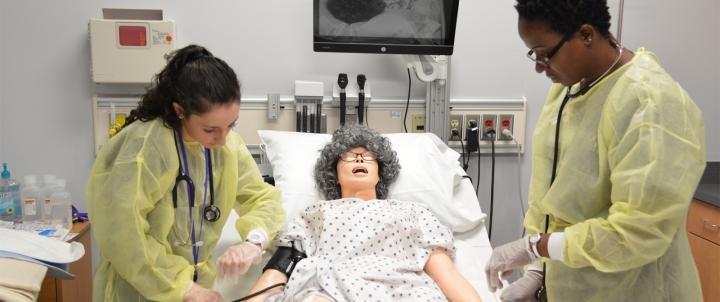
The nursing program at Hood College provides advanced skills for the increasingly complex healthcare field through a focus on leadership, research, evidence-based practices, critical thinking, nursing theory and communications.

The baccalaureate degree program in nursing at Hood College is accredited by the Commission on Collegiate Nursing Education.
The nursing program at Hood College is competitive, and the application process is completed in two steps; students will be accepted to the College before they are evaluated for admission to the nursing program.
For more information about applying to the nursing program as a freshman, click here. For more information about applying to the nursing program as a transfer student, click here.
See our course catalog for more information on this program.
Information will vary based on program level. Select a path to find the information you're looking for!
The nursing program at Hood College is competitive, and the application process is completed in two steps; students will be accepted to the College before they are evaluated for admission to the nursing program.
Check our Nursing Course Sequence here!
MA 112 (or PSY 211 or ECMG 212) is also a required course for nursing; however, it is not included in the 2-course repeat policy.
Students who do not achieve a minimum grade of C in a nursing-required course may repeat that course once to earn a grade of C or better. Students are permitted to repeat a maximum of two nursing-required courses (each only once), to meet the nursing program requirements. The policy includes nursing-required courses taken at other institutions. Students are permitted to repeat one Nursing course (NUR prefix) once.
The Nursing Club is a college-recognized organization of Hood College nursing students that seeks to improve the health of our college community as well as that of the Frederick area.
Our program is accredited by the Commission on Collegiate Nursing Education.
State-of-the-art simulation labs provide hands-on practice in a controlled environment.
Complete clinical fieldwork with local partners such as Frederick Health Hospital, Brook Lane Health Services and the Frederick County Health Department.
Department Chair
 The Hood College nursing programs are approved by the Maryland Board of Nursing and the Maryland Higher Education Commission. The baccalaureate degree program in nursing at Hood College is accredited by the Commission on Collegiate Nursing Education.



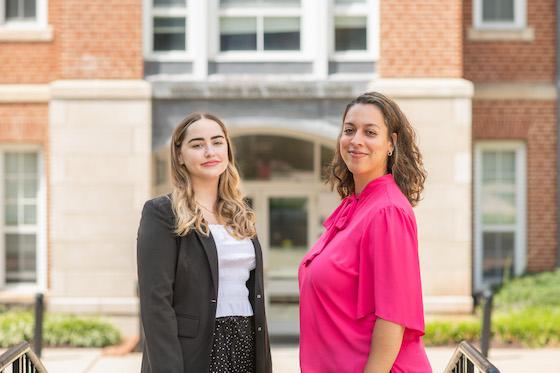
The DAISY Award recognizes the extraordinary work of nurses throughout the country. Hood College nursing alum Jennifer Dumps ’22 and current student Erika Henriquez ’24 are both proud recipients of this honor. In this conversation, they discuss their time in Hood’s nursing BSN program and what it means to be a DAISY Award winner.