
Doctoral Alumni Spotlight | La’Tonya Bryant, DOL’25
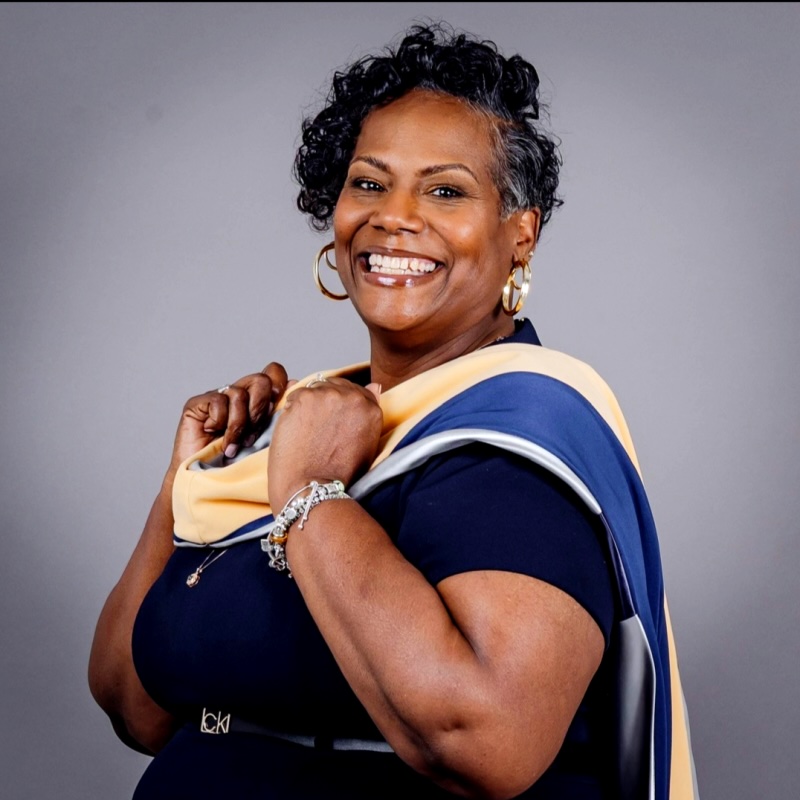
“Hood has become part of both my scholarly and professional journey. It is where my ideas, personal theories and worldview were challenged, where the value of my professional experiences was solidified and where I learned to trust my own voice as a scholar-practitioner.”
Q&A
Program
- Organizational Leadership (Doctorate)
Department
- Delaplaine School of Business & Communication
La’Tonya Bryant, DOL’25, is a public service professional, researcher and Hood College Doctorate in Organizational Leadership alumna whose work explores the intersection of organizational systems, public value, trust and lived experience. Her research focuses on understanding community impact beyond traditional measures, particularly through community-academic partnerships and storytelling.
Tell us about your professional and research journey. What led you to explore community-academic partnerships?
My professional and research journeys are organically connected, although I did not initially recognize that connection. Much of my professional career has been in public service, implementing and working within systems designed to serve people and communities. Long before my doctoral studies, I recognized that systems designed for people do not always impact people the way public servants intend. More directly, what we intend for people to experience and what they actually experience do not always align.
That realization followed me into my doctoral studies. I became increasingly interested in the space between what organizations measure as success and what people experience as value. My dissertation research allowed me to explore that question through the experiences of constituents navigating public service systems, particularly through the lenses of public value and trust. Community-academic partnerships are a natural extension of that inquiry because they bring together two spaces that matter deeply to me: scholarship and practice. At their best, universities bring research, theory and resources into communities, while community partners bring lived experience, contextual knowledge and practical wisdom that can deepen and sometimes challenge what organizations think they know.
Why focus on trust, mutual learning, organizational growth and relationships?
In public service, the voice of the constituency being served matters. Their experiences influence the degree to which they trust the entity providing public services. When it comes to determining program effectiveness, numbers matter, but they do not always tell organizations what changed between people or how people experienced that change. That is what drew me to storytelling as a way of understanding impact. For me, the question became: What might we be missing when we only measure what can be counted? Exploring trust and constituent experience gives us another way of understanding whether a partnership created value—not just for those involved in the partnership, but for those it was intended to serve.
What drew you to Hood College, and what has your experience been like as a member of the Hood community?
What initially drew me to Hood was the opportunity to pursue doctoral study in a way that connected leadership theory with real-world practice. Hood is where my ideas, personal theories and worldview were challenged, where the value of my professional experiences was solidified and where I learned to trust my own voice as a scholar-practitioner. I also found community at Hood. My relationship with Hood has evolved from doctoral student to alumna and engaged community member and, less formally, as a DOL program champion. Since graduating, I have had the privilege of referring three individuals who ultimately chose to become Hood DOL students.
How does your research and professional experience influence the way you teach and mentor students?
In my role as preceptor for service-learning scholars, I approach teaching and mentoring with the belief that theory becomes most meaningful when students can recognize it in the world around them and apply it through real-world service-learning experiences. My research has made me particularly attentive to whose voice is present, whose experience is being interpreted by someone else and whose perspective may be missing altogether. I encourage students to ask questions beyond, Did it work? I want them to consider: For whom did it work? How do we know? Who was involved in defining success? What might the data not be telling us? Ultimately, I want students to examine systems rather than simply accept them as they are.
Are there professors, colleagues, students or experiences at Hood that have been particularly meaningful to you or influenced your work?
One of the gifts of my experience at Hood has been the people who have challenged, encouraged and expanded my thinking along the way. DOL faculty Professor Manikoth, Professor Jose, Professor Cuddapah and Professor Genz helped me move from being an experienced practitioner learning research to seeing myself as someone capable of contributing to scholarship. That transition has been significant for me. These leaders, in particular, piqued my curiosity about the state of government systems and encouraged my exploration of user experience and, ultimately, public value.
What advice would you offer Hood students interested in community-based research or meaningful partnerships?
I would advise Hood students to be curious, listen to understand and value the lived experience of those interacting with systems. It can be enticing to enter a community or organization with a desire to contribute toward meaningful change, but I would encourage students to begin by understanding how the people being served actually experience the system before defining the problem to be solved.
Meaningful partnerships are built with communities, not simply for them. Academic knowledge matters, but so do lived experiences and the perceptions of those who experience and navigate these systems every day. Listen carefully, build relationships and be willing to have your assumptions challenged. Ultimately, whether community work has value is determined by the people in the community for whom the systems were created.
Inspired by La’Tonya’s story? Ready to #GOFURTHER in your career? Learn more about Hood College’s graduate programs, including the Doctorate in Organizational Leadership.
Are you ready to say Hello?
Choose a Pathway
Information will vary based on program level. Select a path to find the information you're looking for!