
Alumni Spotlight | Youssef Aboul-Enein, DOL’25
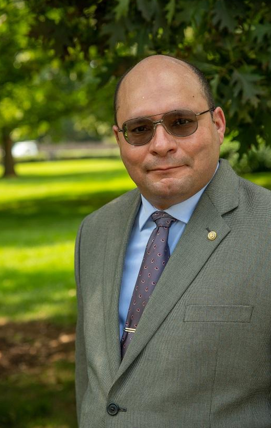
“Hood introduced me to methodologies and new ways of academic analysis that enabled me to uncover why this Iraqi general was lecturing about certain military campaigns. The Hood College doctoral program led to this epiphany.”
Organizational Leadership
Program
- Organizational Leadership (Doctorate)
Department
- Delaplaine School of Business & Communication
Youssef Aboul-Enein, DOL’25, is a retired U.S. Navy Commander with 28 years of active-duty service, including senior roles in intelligence, policy and Middle East affairs during the Global War on Terrorism. A former senior analyst at the Defense Intelligence Agency and the CIA, he is also a published scholar and educator who now consults, teaches and serves as an adjunct professor of political science and doctoral program leader in residence at Hood College.
Tell us about yourself and your professional background.
I retired in 2022 as a U.S. Navy Commander after 28 years on active duty, with deployments that included the First Liberian Civil War, Bosnia and enforcing the no fly zone in Iraq in the mid to late 1990s. I served as a Navy Plans, Operations and Medical Intelligence Officer, including participation in the evacuation of more than 1,500 Americans and allies from Monrovia during Liberia’s civil war. The events of September 11, 2001, changed my life personally and professionally, as I narrowly missed being inside the Pentagon when American Airlines Flight 77 struck. Following 9/11, the need for Arabic linguists and Middle East cultural experts reshaped my career, drawing on my childhood in Riyadh and my education in Saudi schools. I later served on the staff of Secretary of Defense Donald Rumsfeld, retired from the Defense Intelligence Agency as a subject matter expert on al Qaeda and ISIS, and went on to work as a senior intelligence analyst at the CIA. Today, I consult, teach and am honored to join Hood College as an adjunct professor of political science and doctoral program leader in residence.
How did you come to see stamps as a meaningful way to tell complex personal and political stories?
I grew up in Saudi Arabia during the pre-digital 1970s, when reading and listening to shortwave radio were primary forms of connection to the outside world, and I began collecting postage stamps at the age of 7, a hobby that became lifelong. I joined the Saudi Philatelic Society in junior high school and focused on Egyptian monarchy stamps from 1866 to 1953, influenced by my Egyptian roots and family stories about that era. Over time, I built a collection that includes stamps once owned by King Farouk and King Fouad, auctioned in 1954 by the same firm that handled President Franklin D. Roosevelt’s collection. As an intelligence officer and educator, I found stamps to be ideal teaching artifacts, allowing students to engage visually and historically with themes such as pan-Arabism, the fall of Middle Eastern monarchies and post-World War II independence movements. My work in intelligence and philately intersect naturally through detailed historical research and pattern recognition, and with the support of Hood College Hodson Research Librarians, I have published three articles in The American Philatelist.
Was there a discovery during your research that stood out to you?
Two discoveries stood out during my research. The first was uncovering that King Farouk divorced his popular wife Farida on the exact same day his sister Princess Fawzia was divorced, November 17, 1948, a coincidence for which no clear explanation exists and which raises questions about palace politics and public distraction. The second involved King Farouk’s unpopularity, which led Egypt to ban the 1951 MGM film Quo Vadis out of fear that audiences would associate the portrayal of Emperor Nero with the king himself, resulting in public jeers and hisses. These findings illustrate how deeply public sentiment had turned against the monarchy, culminating in its overthrow by army officers in July 1952.
Why did you choose Hood College for your doctoral studies?
I discovered Hood College through my son Omar, who completed his master’s degree here in 2021, the same year I began the doctoral program, and found it to be a strong fit geographically and professionally for working leaders. More importantly, the doctoral program in organizational leadership offered the flexibility to pursue unconventional research, allowing me to study Iraqi General Ala al Din Khammas and introduce his ideas on warfare to a new generation of American military leaders. Hood exposed me to new methodologies and analytical frameworks that helped me understand why this general referenced seventh century Middle Eastern campaigns during the Iran-Iraq War and encouraged me to use archival research at the Hoover Institution, leading to a major intellectual realization about the parallels between his work and my own career.
Were there particular professors or experiences that shaped your doctoral work?
My dissertation committee, Professors Corey Campion, Jennifer Cuddapah and Karen Hoffman, challenged me to analyze my subject through post modern spatial and identity theories, helping me uncover strategic meaning in his writings on medieval warfare. Nisha Manikoth helped me understand the fundamental difference between writing a dissertation and writing books, which was critical given my background as an author. I would also be remiss not to mention Marcella Genz, who played a key role in refining my dissertation and supporting research for my philatelic articles, including my recent work on Egypt’s royal wedding stamps, reinforcing my belief that rigorous scholarship depends on strong faculty mentorship and research librarians.
What advice would you offer to current Hood doctoral students?
My advice is to research and write about what you are truly passionate about and to view the dissertation process as a way of first teaching yourself before teaching others. Writing a dissertation requires perseverance, and feedback from faculty and cohort members should be embraced as a means of refining your craft as a writer and speaker. To paraphrase Professor Cuddapah, trust the process, and as my Cohort 6 motto states, focus and finish, because the Hood doctoral faculty and peer community are essential in helping students avoid becoming perpetual researchers and in guiding them toward meaningful completion.
Inspired by Youssef’s story? Ready to #GOFURTHER in your career? Learn more about Hood College's graduate programs, including the doctoral program in organizational leadership.
Are you ready to say Hello?
Choose a Pathway
Information will vary based on program level. Select a path to find the information you're looking for!