
Graduate Faculty Spotlight | Dom Esposito
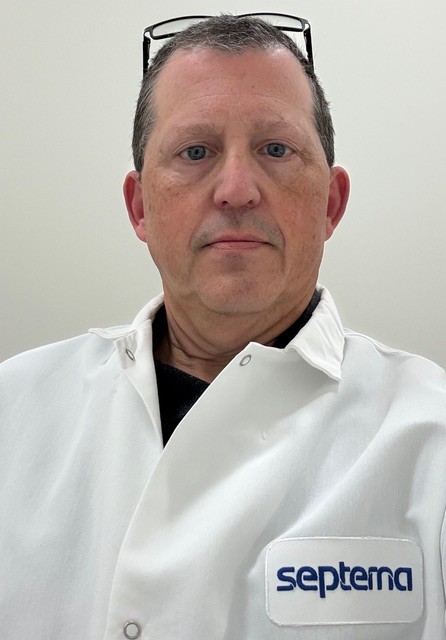
“I want my students to have a deep understanding of the topic and a desire to learn more about parts of it that might be interesting to them.”
Biomedical Science
Department
- Biology
With an accomplished career spanning two decades in biotechnology and protein science, Dom Esposito, Ph.D., brings a wealth of expertise to Hood College. Trained as a biochemist with degrees from La Salle University and Johns Hopkins University, he has held prominent roles at the National Institutes of Health and the Frederick National Laboratory for Cancer Research. He currently serves as senior director of protein sciences at Septerna, focusing on drug discovery for G-protein coupled receptors. Since 2006, he has also been a dedicated adjunct professor at Hood, teaching courses in chemistry, oncology drug discovery and protein science.
Tell us about your educational and career background.
I have a bachelor’s degree in chemistry and biochemistry from La Salle University in Philadelphia and a doctorate in biochemistry and diophysics from the Johns Hopkins University Bloomberg School. After a postdoctoral fellowship at the NIH, I spent a few years working for Life Technologies (now part of Thermo Fisher Scientific). In 2001, I moved to the Frederick National Laboratory to a group called the Protein Expression Laboratory (PEL) that developed new technologies for making recombinant proteins and supported science across the NIH. I stayed there for 24 years, eventually becoming the director of the PEL and working as part of the team that ran the National Cancer Institute’s RAS Initiative, a drug discovery program to develop therapeutics to target some of the worst cancers.
In October of this year, I moved across the country to join a small biotech, Septerna, as a senior director of protein sciences working on drug discovery for G-protein coupled receptors. I started teaching as an adjunct professor in the chemistry department at Hood in 2006 and subsequently taught a number of courses in the biomedical science graduate program as well, including Oncology Drug Discovery and an Introduction to Protein Science.
As a faculty member, do you have a certain mindset, theory or teaching style?
I wouldn’t really call it a theory—but I believe in an interactive classroom that is more focused on making sure students understand the theory rather than just memorizing facts and information that they could look up on a Google. For that reason, I emphasize class participation and presentations more than exams or homework. For modern-day scientists, being able to present your data and explain it to other people is infinitely more important than memorizing what the structure of an amino acid is—those things will come with experience or from a textbook, but really deeply understanding a topic and being able to explain it to your peers is so much more valuable. If I wasn’t required to grade students, I wouldn’t have tests at all honestly, but as it is, I tend to value presentations, journal clubs and participation much more in the overall scheme of the classes.
What would you like your students to take away from your classes?
I want my students to have a deep understanding of the topic and a desire to learn more about parts of it that might be interesting to them. For my Protein Science class, I taught students basically how to do my job—often by providing real-world examples that they could then use to better understand how protein scientists make decisions. By having them independently research their own topics of interest and present to the class, they were then able to apply a lot of this knowledge and go much deeper than a textbook would. For the BMS program, where many people are already in industry jobs or are planning to go that route, getting this deep understanding of the field is incredibly valuable for their careers.
Why Hood College? What made you choose to teach here?
Honestly, it was the only local school and the only place that offered the opportunity! Initially, I was skeptical of teaching General Chemistry more than 15 years after I had graduated from college and having never taught classes, but thankfully the chemistry department staff were very accommodating and helpful in getting me started, and it turned out to be a great experience. My wife was a graduate from Hood, so I was familiar with the school, and ultimately both of my kids ended up attending school there as well. And over the past 24 years, I had the pleasure of hiring a LOT of Hood graduates (both undergraduate and graduate BMS students) in my lab at FNL, so there are a lot of great connections locally that made Hood a good choice.
How does your professional scientific experience influence your teaching or mentorship at Hood College?
I think one of the best things about having professional industry scientists teaching in this program is that they bring a huge amount of real-world experience to the students that they may not have received otherwise. Many faculty members at Hood have not had the opportunity to keep up with all of the cutting-edge science going on in industry—no one could possibly be able to do that. So bringing in experts in areas to complement the core courses being taught by full-time faculty really helps to round out the program and give students a chance to see things that they may not otherwise have had exposure to. It’s been very exciting to be able to teach students about the things that I’ve worked on in my career, and there’s no better person to teach than someone who lives and breathes the specific science every day.
You’ve been a strong supporter of the biomedical science (BMS) program. What excites you most about the program and the opportunities it creates for students?
That expertise that the BMS faculty bring to the table gives students a lot of opportunities to explore areas of science they may not have known about, and maybe that will drive their decisions about future careers. In addition, having a lot of faculty members in local industry gives Hood BMS students a leg up in potentially finding employment opportunities nearby. As a hiring manager, it was good to have feedback from faculty members that I knew and trusted if a Hood student applied for a job in my lab. Often, students were able to intern in our lab or visit and talk to people in the lab, and that also could lead to additional opportunities. 90% of hiring these days is based on networking and connections—when we see hundreds of applicants for a job, there has to be something that helps differentiate the candidates, and that is a big advantage of a program like BMS.
Inspired by Dom's story? Ready to #GOFURTHER in your career? Learn more about Hood College's graduate programs, such as biomedical science.
Are you ready to say Hello?
Choose a Pathway
Information will vary based on program level. Select a path to find the information you're looking for!