
Graduate Faculty Spotlight | Randy Johnson, Ph.D.
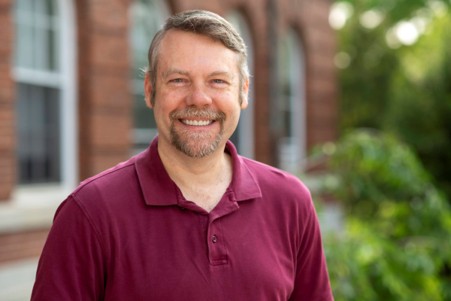
“We want students to understand why they are doing things and to step more into an engineering headspace, where they can direct things and make things happen rather than just doing what someone else tells them to do.”
Bioinformatics
Program
- Bioinformatics (M.S.)
- Bioinformatics (Certificate)
Department
- Biology
- Computer Science & Information Technology
Randy Johnson, Ph.D., is the director of Hood College’s bioinformatics M.S. program and a data scientist with more than 20 years of experience at the National Institutes of Health. With a background in statistics, bioinformatics and genetics, his research experience spans areas including cancer, HIV/AIDS, malaria and conservation genetics.
Tell us about your professional and research journey. What ultimately led you to the field of bioinformatics?
My background is in statistics and bioinformatics with genetics. I worked at the National Institutes of Health (NIH) as a data scientist for more than 20 years before moving to Hood full time last year. I initially started at Hood as an adjunct in 2017 while I was still at NIH, and I am now the director of the bioinformatics program. I’ve been working in this field for about 22 years, and I’ve really enjoyed being at Hood.
You have been involved in a variety of research programs throughout your career. What areas of research are you most passionate about, and what continues to drive your interest in this work?
What keeps me interested is that there are so many fascinating problems and so much data to work with in this field. There is no shortage of interesting problems and projects. I’ve gotten to work on everything from malaria and ticks, cancer, HIV/AIDS and even conservation genetics with elephants. It is always interesting to work on something new, and the analysis tools I use are broadly applicable across many different areas. From my perspective, these are related problems, even though from a biological perspective they involve different species and systems.
What brought you to Hood College, and how has your experience as director of the bioinformatics program shaped your perspective on graduate education?
I had been involved in training and mentoring for a couple of decades and mentored probably 10 or 15 students while I was at NIH. In 2017, one of my colleagues was asked to teach a class at Hood but couldn’t do it and asked if I might be interested. That was how I first became acquainted with Hood’s bioinformatics program. I really enjoyed teaching as an adjunct and eventually decided I wanted to teach full time. My perspective on education has also changed quite a bit, especially with the advent of AI. A lot of my thought now goes into helping students understand the foundations and see the big picture, while appropriately using AI to fill in some of the details. AI might get them 80% of the way there, but they still need the knowledge to fill that gap and bring the work across the finish line.
Bioinformatics brings together areas such as biology, computing and data analysis. How does Hood’s bioinformatics program prepare students to work across these different disciplines and apply their skills to real-world research?
I describe bioinformatics as data science for biology. It really boils down to applying computer science, statistics and math to problems in biology. We want students to understand why they are doing things and to step more into an engineering headspace, where they can direct things and make things happen rather than just doing what someone else tells them to do. Many of our students are already working full time while going to school, and some begin applying bioinformatics tools and methods in their jobs before they even graduate. Others go on to Ph.D. programs, research positions or roles with startup companies.
Are there any research opportunities, collaborations or experiences at Hood that you feel have been particularly valuable for bioinformatics students?
For the master’s degree, students complete a final project, either a capstone or, if they want something more in-depth, a thesis. If they don’t already have a project through their work, we try to connect them with collaborators, including local researchers at places like Fort Detrick. We also recently had a student work with a collaborator of mine at Rocky Mountain Laboratories in Montana. Certificate students have a practicum where we work through several projects using real data. Sometimes students try to replicate findings from published research, and we also have projects involving tool development, such as building a dashboard to automate quality-control analysis that had previously been done manually in spreadsheets.
What advice would you give to current or prospective students interested in pursuing bioinformatics, particularly those hoping to become involved in research?
I would encourage people to give it a try. The best way to learn this stuff is by doing it because it is complicated. You can read about how it is done, but until you actually put your fingers to the keyboard and start working, it is all theoretical. Through that practice and actually working with data, you learn a lot. I’ve seen people come into the field from different backgrounds. One student came in with a biology undergraduate degree and was working as a librarian, and now she is at NIH working on bioinformatics projects and doing really interesting research. If you are interested and willing to learn, you can pivot into the field.
Inspired by Professor Johnson’s story? Ready to #GOFURTHER in your career? Learn more about Hood College’s graduate programs, including bioinformatics.
Are you ready to say Hello?
Choose a Pathway
Information will vary based on program level. Select a path to find the information you're looking for!