
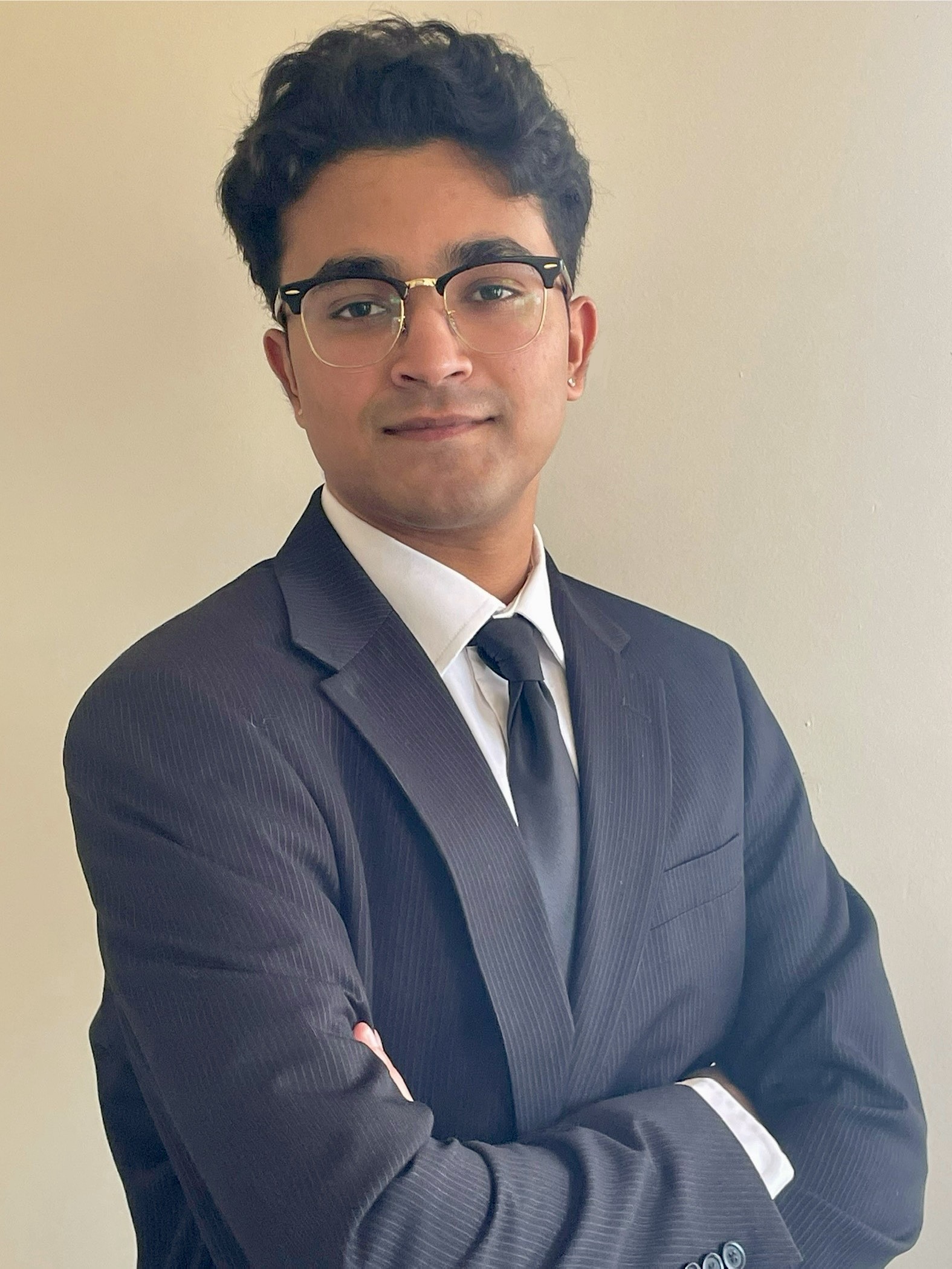
3MT Winner Spotlight | Venkata Krishna Kandalai, M.S.'26
"The People's Choice is voted on by the audience, so it is not a panel of judges scoring your methodology, but real people saying your work resonated with them."
People's Choice Award Winner
Program
- Health Informatics (M.S., Certificate)
Department
- Computer Science & Information Technology
- Nursing
Combining healthcare and technology in meaningful ways, Venkata Krishna Kandalai, M.S.’26, is using innovation to tackle real-world challenges in modern medicine. A health informatics master’s program graduate from Hood College and current postgraduate intern at AI CoLab, the MedStar-Georgetown Collaborative Center for AI in Healthcare, Venkata recently earned the People’s Choice Award at Hood College’s Three Minute Thesis (3MT) competition. His presentation highlighted “FHIR Cracker,” a project designed to transform unstructured clinical notes into standardized healthcare data, helping improve care coordination, research and patient outcomes. Through his research, Venkata is demonstrating how artificial intelligence and health informatics can make healthcare systems smarter, more efficient and more accessible.
Tell us about yourself and your research topic presented at the 3MT competition.
My name is Venkata Krishna Kandalai. I’m a health informatics master’s program graduate from Hood College and currently a postgraduate intern at AI CoLab, the MedStar-Georgetown Collaborative Center for AI in Healthcare. For my capstone, I built a project called FHIR Cracker, a tool that takes unstructured clinical text, like the kind doctors write in discharge summaries, and automatically converts it into a standardized format that health systems can actually use. The 3MT was my chance to tell that story in three minutes.
What inspired you to pursue this research, and why is it important?
Healthcare generates enormous amounts of written notes—doctor observations, patient histories, discharge instructions—and most of it just sits there, unorganized and hard to use. It struck me as a huge missed opportunity. If we can turn that raw text into structured, usable data, it unlocks so much: better care coordination, smarter clinical research and more personalized treatment. I kept thinking that if the information is already there, we just need the right tools to unlock it. That became FHIR Cracker. Beyond the technical problem, I was motivated by the real-world stakes. This kind of work can directly improve how patients are cared for, and that matters a lot to me.
How did you prepare to present your work within the three-minute format?
I had to think in terms of a general audience member who would be present at the event, not someone interested in the detailed tech stack I worked with. I removed all the jargon and complex concepts that might pull people away from the big picture problem I was trying to solve. It was a big trial and error process to nail the right level of complexity in under three minutes. I typed out the full talk and read it aloud over and over to catch places where it felt clunky or rushed. I also watched past 3MT winners to understand the rhythm. The practice session with Dean April Boulton was genuinely transformative. I walked in with one slide and walked out knowing I needed a completely different one. That feedback changed everything.
How did it feel to receive the People’s Choice Award?
It still feels surreal. The People’s Choice is voted on by the audience, so it is not a panel of judges scoring your methodology, but real people saying your work resonated with them. That felt incredibly meaningful, because accessibility was something I worked really hard on. I wanted someone with no healthcare or tech background to walk away genuinely understanding why this problem matters. Winning that award told me the message landed. And having people I care about in the room celebrating with me made it even better.
What advice would you give to future 3MT participants?
Try as much as you can to focus on the big picture of your project rather than worrying about which small details to cram into three minutes. Think like an audience member to gauge how technical or plain your language sounds. I practiced by explaining my project to family and friends, which helped me stay within the time limit while making sure a non-technical person could understand what I was trying to achieve. Lastly, attend the practice session. It was very helpful, and Dean Boulton knows exactly what you can improve on your slide and will give you some well-deserved confidence going in.
Inspired by Venkata's story? Ready to #GOFURTHER in your career? Learn more about Hood College’s graduate programs, including the master's in health informatics.
Are you ready to say Hello?
Choose a Pathway
Information will vary based on program level. Select a path to find the information you're looking for!