
Graduate Alumni Spotlight | Jena Pinkard and Rena Arnon
“Preparing for SPIRES was challenging, but also very rewarding. Our project changed and developed over time as we refined our research question, methods, data and presentation. That process taught us a lot about flexibility, organization and how to communicate research clearly.”
Nutrition Science, Dietetics
Program
- Nutrition Science (M.S.), Dietetics Track
Department
- Nursing
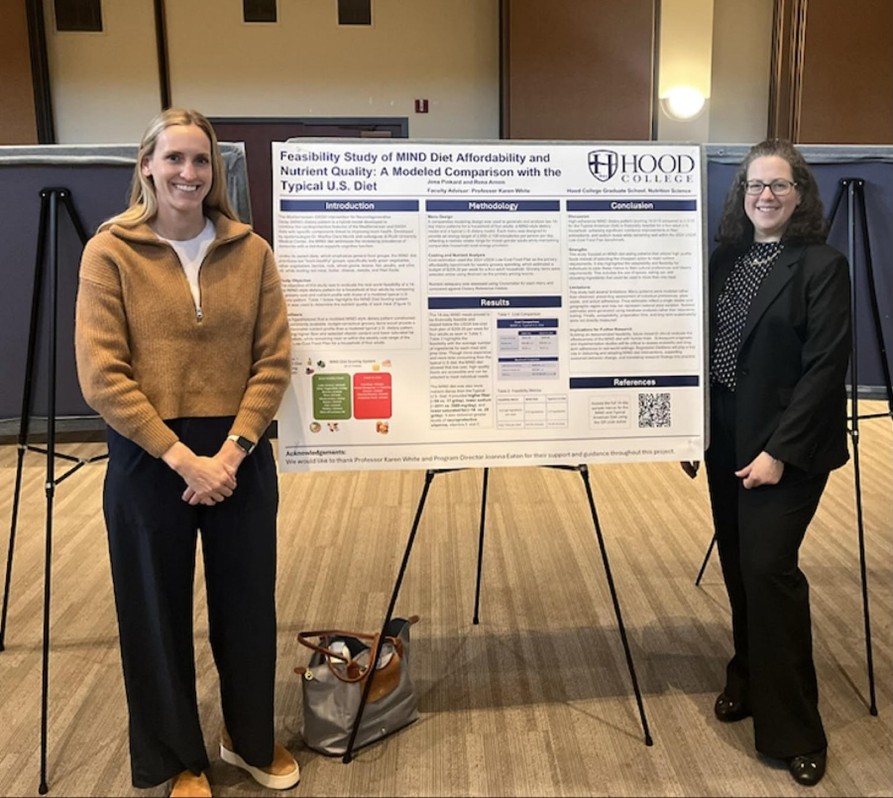
Jena Pinkard, M.S.’26, and Rena Arnon, M.S.’26, are recent graduates of Hood College’s master’s program in nutrition science. Arnon and Pinkard are winners of the SPIRE Symposium for their outstanding poster for “MIND Diet Affordability and Nutrient Quality: A Modeled Comparison with the Typical U.S. Diet.” We spoke with Arnon and Pinkard on their experiences in the nutrition science program and what it was like presenting research at the SPIRE Symposium.
Congratulations on your award-winning presentation at the SPIRE Symposium! Can you tell us a bit about your research and what inspired you to explore this topic?
Arnon: We looked at the nutritional quality and cost of a MIND-style eating pattern compared with a planned Typical American Diet. We chose the MIND diet because it is an evidence-based eating pattern associated with cognitive health and also reflects many recommendations used to support cardiometabolic health. The MIND diet combines elements of two well-established dietary patterns: the Mediterranean diet and the DASH diet. It emphasizes foods such as vegetables, berries, beans, whole grains, nuts, fish, poultry and olive oil. For our project, we created two two-week menus, one modeled after the MIND diet and one modeled after a more typical American eating pattern, and priced the foods using Walmart grocery costs to compare them for affordability, nutrient density and alignment with evidence-based nutrition recommendations.
Pinkard: We studied the Mediterranean and DASH diets extensively throughout our program and were interested in how the MIND diet combines elements of both while offering a newer area of research to explore. We were especially excited about the diet’s feasibility and its relevance for dietitians and nutrition professionals.
Our research grew out of a practical question we kept coming back to as future dietitians: when we recommend evidence-based eating patterns or national dietary guidelines for overall health and disease prevention, are those recommendations actually affordable and realistic for the people and communities we hope to serve?
Arnon: Another reason these topics interested us is that many evidence-based nutrition recommendations apply across life stages and overlap in areas like cardiovascular health, hypertension, diabetes prevention, healthy aging and cognitive health, but many people still struggle to adopt them. We were especially interested in how people can move toward a more nutrient-dense eating pattern in small steps, without feeling like they have to completely overhaul their lives or the ways they like to eat.
What was the experience of preparing for and presenting at SPIRES?
Pinkard: We didn’t know exactly what to expect, so it was both a new and exciting opportunity. I really enjoyed speaking about our work and hearing people’s perspectives on our topic. Many of the people we spoke with at SPIRES shared personal stories related to our research, which was very meaningful and reinforced the importance of our work. Presenting at SPIRES was rewarding because it allowed us to share the effort we put into our research with others who were genuinely interested in learning about it.
Arnon: Preparing for SPIRES was challenging, but also very rewarding. Our project changed and developed over time as we refined our research question, methods, data and presentation. That process taught us a lot about flexibility, organization and how to communicate research clearly. It also helped me appreciate that research is often an iterative process. The project did not stay exactly where it started, but each revision helped us make the question, data and final presentation stronger.
Presenting at SPIRES gave us the opportunity to share work that brought together many parts of our graduate training, including nutrition science, food systems, sustainability, chronic disease prevention and community nutrition. It was especially meaningful to present work that felt practical and connected to the kind of real-world questions dietitians often ask: How do we take evidence-based recommendations and make them realistic, accessible and useful?
What drew you to pursue your graduate studies at Hood College, and how has your experience in the nutrition science program been so far?
Pinkard: I was drawn to Hood because of its small class sizes, hybrid learning format and the built-in supervised experiential learning hours within the dietetics track. As someone who changed careers, I was nervous at first, but my experience at Hood built my confidence and provided me with the education and support needed to pursue a new career as a dietitian.
Arnon: I was initially drawn to Hood because it offered an ACEND-accredited Master of Science in Nutrition Science program with a dietetics track. I also appreciated the hybrid structure because it allowed me to have both flexibility and a real connection to classmates, faculty and campus life.
Having just graduated, I can say that my experience at Hood has been transformative. The program was rigorous, but it also went far beyond classroom learning. We had opportunities to apply what we were learning through simulations, writing assignments, research, supervised practice rotations, community projects and professional presentations. Hood gave me the structure and support to grow into the professional role gradually, building confidence not only in my knowledge, but also in my ability to communicate, reflect, adapt and grow as a future dietitian.
How has Hood College supported you in developing your research, presentation skills and confidence as a graduate student?
Arnon: Hood supported those skills through a combination of close faculty mentorship, applied coursework, reflective assignments and supervised practice experiences. The curriculum consistently emphasized evidence-based practice, writing, feedback and professional communication.
We had close contact with professors, our program director and preceptors, all of whom helped us connect coursework to real practice. Through the program, we were asked to communicate with patients, medical teams and other professionals; develop educational materials; present our work; and engage with clinical sites and community nutrition programs across Maryland. Those experiences gave me a hands-on understanding of how food, nutrition, health and community needs intersect in everyday life, helping me become more confident in taking academic knowledge and using it in professional and community settings.
Pinkard: Hood provided many opportunities to strengthen my research and presentation skills throughout our capstone project, which we later presented at SPIRES. We completed two courses dedicated to developing our research, and we also worked closely with the library staff to better understand the academic resources and support available to us. We also gained hands-on experience in the field of dietetics throughout our program, which helped build both confidence and professional skills.
Are there any professors, mentors or experiences at Hood College that played a key role in helping you succeed with your SPIRES presentation?
Pinkard: Both Joanna Eaton, our program director, and Karen White, our capstone project professor, played key roles in helping us succeed with our SPIRES presentation. We also gained valuable experience presenting at another conference beforehand, which helped strengthen our confidence and presentation skills. Joanna and Karen provided guidance throughout the project, helped refine our topic and offered feedback on our poster to ensure we communicated our information effectively. We are both incredibly grateful for their support during SPIRES and throughout our time in the program.
Arnon: Additionally, Professor Emily Spear, RDN, who taught a Food Systems, Global Health and Sustainability course, inspired our cohort to think about nutrition beyond the individual or clinical level and consider broader community, cultural and food systems contexts. The topics we covered and our visits to local food banks and health fairs influenced how I thought about this project and why affordability and accessibility mattered so much. Overall, the support of Hood faculty and our preceptors helped prepare us to approach this project with both scientific rigor and practical relevance.
Pinkard: I am also very grateful to have had Rena as a partner (and now great friend!) on such a significant project. Having someone who is equally dedicated and passionate about the work made the experience even more meaningful. Few people get to have that kind of collaborative experience in an academic setting, and working with her has been one of the highlights of my graduate program.
What advice would you give to other students who may be interested in participating in research competitions or presenting their work in the future?
Arnon: My biggest advice is not to be afraid to try, even if the project feels intimidating at first. Research does not have to start out perfectly formed. Our own project changed several times as we learned more, received feedback and figured out what was realistic. Sometimes what you think you can study at the beginning is different from what you are actually able to do well, and that is part of the process. Being willing to adapt can make the final work stronger.
I would also encourage students to start with a topic they are genuinely interested in because that interest helps sustain the work when the process becomes challenging or the results are not exactly what you expected. Also, use the guidance and resources provided by the library and your professors, and stay organized with data, references and deadlines.
Finally, if you are working with a partner, choose someone you communicate well with and who shares your commitment to the final result. Group work can feel daunting, but it can also be one of the best ways to strengthen communication, flexibility and collaboration skills that are important in professional life. Working with Jena was central to the success of this project. We brought both shared values and different strengths to the work, and I learned so much from her about how to distill evidence clearly and present it in a visually engaging, easy-to-understand way. Our collaboration made the final poster stronger and made the whole process of presenting it less intimidating and more meaningful.
Pinkard: I would say go for it, even if it is new and unfamiliar. Be prepared, seek feedback from peers and professors beforehand and, most importantly, enjoy the experience. It is an exciting opportunity to share your hard work, and the people attending are genuinely interested in learning about what you have accomplished.
Inspired by Jena and Rena’s story? Ready to #GOFURTHER in your career? Learn more about Hood College’s graduate programs, including nutrition science.
Are you ready to say Hello?
Choose a Pathway
Information will vary based on program level. Select a path to find the information you're looking for!