
Maimouna Diouf ’26 | Innovation Challenge
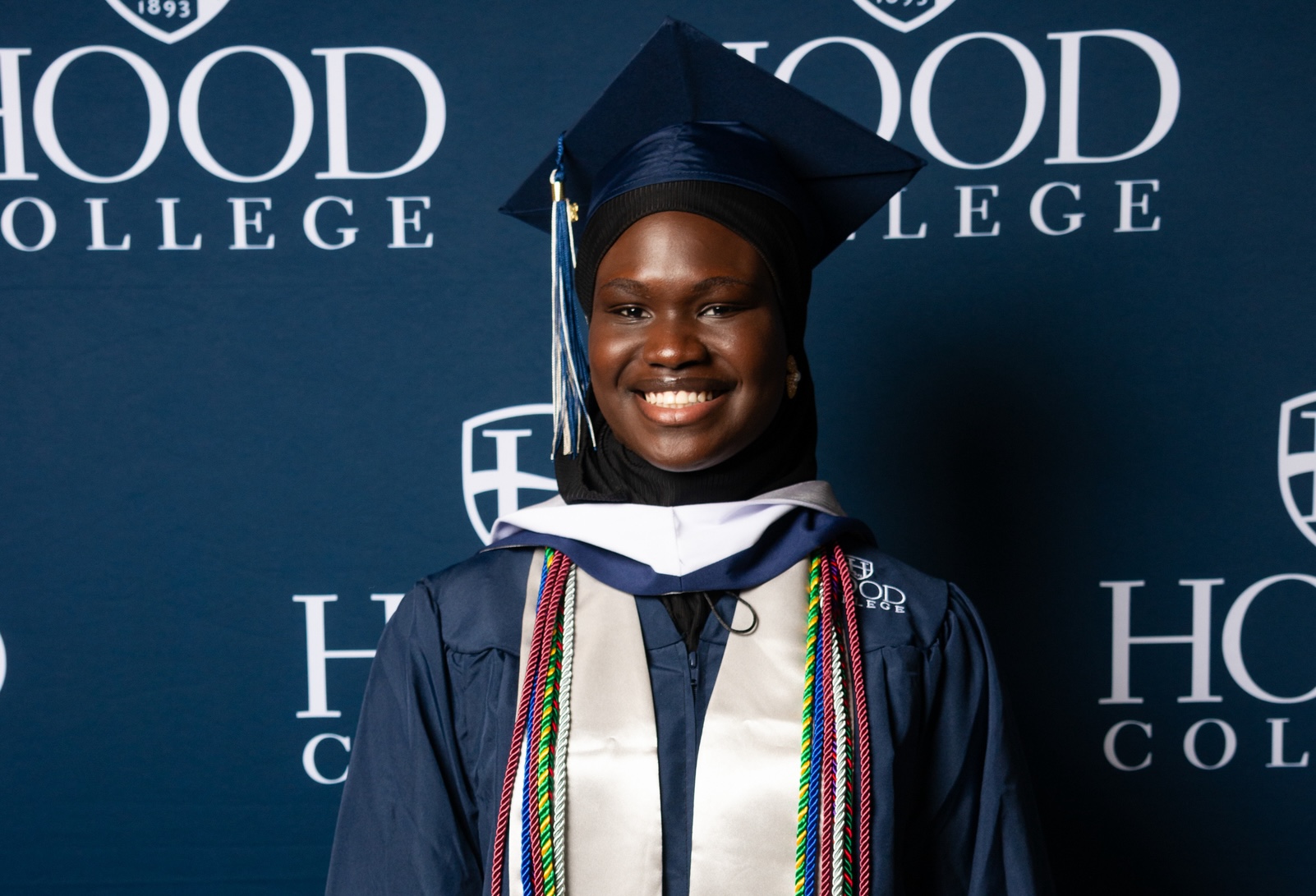
Maimouna Diouf ’26 developed a conceptual app to predict signs of Alzheimer’s as part of the BREC Innovation Challenge.
Worth the Work
Graduation Year
2026
Program
- Environmental Biology (M.S.)
- Pre-Professional Preparation
Department
- Biology
Maimouna Diouf ’26 majored in biology and was part of the pre-med professional preparation program at Hood College. She participated in the 2026 Innovation Challenge hosted by the Bioscience Research and Education Center, where she and partner Maria Bernal ’23 developed a conceptual memory game app to predict early signs of Alzeimer’s.
How did you become involved with the Innovation Challenge?
I became involved in the Innovation Challenge through receiving emails from the Career Center. I was really interested in the opportunity to work on a real-world problem in a collaborative, hands-on environment. It felt like a chance to apply what I have learned in a more practical and creative way.
Tell us about your project—how did you develop your concept of a memory game to detect signs of Alzheimer’s?
Our project focused on developing an app that uses interactive memory-based games to help detect early signs of Alzheimer’s and other forms of dementia. We started by researching early symptoms, especially subtle memory and cognitive changes, and realized that consistent, low-pressure testing through games could be a more accessible way to monitor those changes over time. From there, we decided that our app would be designed for simple activities that track patterns like recall, reaction time and consistency, which could potentially signal early cognitive decline.
How did you go about conducting market research for your concept?
We approached market research by looking at existing cognitive health apps and tools as well as identifying gaps in accessibility and early detection. We also considered our target users—older adults and especially their families—and thought about usability, access, cost and comfort with technology. In addition, I reviewed research on cognitive assessments to better understand what features would make the app both effective and user-friendly.
In what ways did the Innovation Challenge project complement your Hood major?
This project complemented my biology major by allowing me to apply concepts like scientific skills, research, data analysis and healthcare knowledge in a real-world context. It pushed me to think beyond theory and consider how ideas can be translated into practical solutions that impact people’s lives.
What were the biggest takeaways from your project? What did the experience teach you?
One of my biggest takeaways was the importance of teamwork and interdisciplinary thinking, which brought together different perspectives and really strengthened our project. I also learned how important it is to focus on the user experience, especially when designing something for a sensitive issue like cognitive decline. Overall, it taught me how to take an idea from concept to a more developed solution while thinking critically about its real-world impact.
Why do you think hands-on, experiential learning projects like the Innovation Challenge are beneficial for students?
I think these kinds of projects are valuable because they bridge the gap between academic learning and real-world application. They help students develop problem-solving, communication and critical thinking skills while working on meaningful challenges. It also gives students a chance to explore their interests and build confidence in their ability to create solutions that could make a difference.
Learn more about the biology major and the Bioscience Research and Education Center.
Are you ready to say Hello?
Choose a Pathway
Information will vary based on program level. Select a path to find the information you're looking for!