Career Outlook
The Bureau of Labor Statistics projects 11% growth for nutritionist and dietitian jobs by 2030, faster than the national average.

The Master of Science in Nutrition Science (Nutrition Science Track) at Hood College prepares graduates to apply nutrition science in leadership, management, public health, and community-based settings, with an emphasis on systems-level thinking, program planning, and population health. This non-dietetics track is designed for professionals seeking to lead, manage, and innovate in nutrition-related roles across public health, education, nonprofit, corporate, and community organizations.

Tuition & Fees
Funding Opportunities
Deeply rooted in chemistry, biology and the social sciences, nutrition is the study of nutrients and bioactive compounds in the foods we eat. Through analyzing their metabolic and physiological function, nutritionists and dietitians work to prevent and treat a range of diseases and conditions.
Our program trains you to understand the relationship between diet, health and disease. You will be prepared to work within a wide range of related fields, including dietetics, clinical nutrition, food security, molecular nutrition, public health, nutritional biochemistry and immunology. Courses are offered in a hybrid format (combination of in-person and online courses). The nutrition science track is designed to help prepare you for evidence-based advanced practice, perfect for registered dietitians who wish to enhance their credentials.
HOOD Talks Lecture Series
Professor Eaton recently presented at Hood College's HOOD Talks lecture series on 'Mindful and Intuitive Eating.' Click here to see a record of her lecture.
1) Statement of Purpose (no greater than 2 pages, double-spaced) that discusses:
2) A baccalaureate degree in nutrition from an accredited institution with a cumulative GPA of 3.0 or above.
or
A baccalaureate degree from an accredited institution with a cumulative GPA of 3.0 or above and completion of the following prerequisite courses with a grade of C or better: chemistry, organic chemistry, biochemistry, anatomy and physiology, introduction to nutrition or principles of nutrition, and food science of experimental foods.
Applicants who have an undergraduate GPA below 3.0, must also submit two letters of recommendation (letters can be emailed to gofurther@hood.edu).
A total of 32 credits are required for the nutrition science track. 17 core credits and 15 electives are required.
Core (18 Credits Required)
MATH 500 - Research Methods/ENV 505 Biostatistics/BIFX 503 Statistics for Bioinformatics (3 credits)
NUTR 500 – Food Systems, Global Health and Sustainability (3 credits)
NUTR 505 - Leadership, Management and Advocacy, Seminar (2 credits)
NUTR 509 - Program Planning, Management and Evaluation (3 credits)
NUTR 530 – Health Communications (3 credits)
NUTR 579A - Nutrition Non-thesis Research (3 credits)
NUTR 579B- Nutrition Capstone (1 credit)
Total Core Credits: 18
Electives (14 Credits Required)
COUN 504 Counseling Techniques (3 credits)
HIFX 500- Fundamentals of Health Informatics (3 credits)
HIFX 502- Introduction to US Healthcare Systems and Economics (3 credits)
NUTR 504 - Advanced Nutritional Biochemistry Seminar (2 credits)
NUTR 525 food Service Management (2 credits)
NUTR 556 – Nutrition Across the Lifespan (3 credits)
NUTR 599 - Special Topics in Nutrition (3 credits)
ENV 501 - Introduction to Environmental Biology (3 credits)
SUS 415/NUTR 515 - Urban Agriculture (3 credits)
SUS 410/NUTR 510 - Bioengineering for Sustainability (3 credits)
BMS 512 - Biochemistry of Intermediary Metabolism (3 credits)
Total Elective Credits: 14
Upon completion of this concentration, you will be able to:
The Bureau of Labor Statistics projects 11% growth for nutritionist and dietitian jobs by 2030, faster than the national average.
Our Accreditation Council for Education in Nutrition and Dietetics (ACEND) accredited program equips you with expert training as prioritized by the Academy of Nutrition and Dietetics and the American Society of Nutrition.
Frederick Health, Frederick County Public Schools, Adventist HealthCare and Kaiser Permanente are among numerous regional organizations that actively recruit dietitians and nutritionists.
| Median Salary (Public Data) | Job Titles | Companies of Employment |
|---|---|---|
| $62,000 | Registered Dietitian Nutritionist (RDN) | Frederick Health Hospital |
| Clinical Dietitian | National Institutes of Health (NIH) | |
| Nutrition Research Associate | Frederick County Public Schools | |
| Health & Wellness Consultant | WIC (Women, Infants, and Children Program) | |
| Nutrition Educator | Food and Drug Administration (FDA) |

Program Director, Nutrition Science

Assistant Director of Graduate Admission
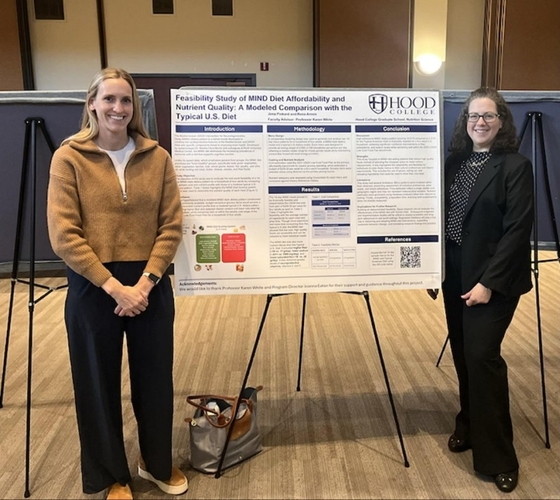
“Preparing for SPIRES was challenging, but also very rewarding. Our project changed and developed over time as we refined our research question, methods, data and presentation. That process taught us a lot about flexibility, organization and how to communicate research clearly.”

“I feel in the experience as a whole, the people are really where it shines.”

With new requirements to become a registered dietitian nutritionist (RDN), our master’s in nutrition science is the pathway to licensure.