
Best of Global Studies
Tel: 301-696-3227
Email: campion@hood.edu
Office: Rosenstock Hall, Room 302
Professor of Political Science, Chair of the Department
Tel: 301-696-3699
Email: eager@hood.edu
Office: Tatem Arts Center, Room 121H
Office hours: By appointment
What brought you to Hood College?
I always wanted to teach in a small, liberal arts college environment. I value the personal interactions with the students in this setting as well as the ability to get to know and work with faculty across academic disciplines. Often, those opportunities are more difficult to come by in a larger university setting. I was inspired by the teacher-scholar model that Hood College implements and emulates and was excited about the prospect of having the ability to create new courses in my area of specialization.
What Global and International Studies related courses do you teach?
I teach Introduction to Global Studies (GLBS 200), which is required for the major. This course gives students the opportunity to see how history, economics, political science, foreign languages and many other academic disciplines are all necessary to understanding current, complex global issues. In addition to GLBS 200, I also teach Introduction to International Relations, Politics of Developing Countries, Political Violence and Terrorism, and the Global Studies Senior Seminar (GLBS 470). Most of the courses I teach are under the “Global Governance and Conflict” thematic concentration within the Global Studies major.
What attracted you to the field of global and international studies?
As an undergraduate student, I was a double major in Communication Arts and Political Science. I took a class on the Arab-Israeli conflict, and I was hooked. I realized then how important it was to understand current conflicts and the potential for peaceful resolutions to them from multiple perspectives. In addition, I was an undergraduate student when the Rwandan genocide occurred in 1994. I had obviously studied the Holocaust, but I never thought that the world would stand by and watch another mass slaughter of people. I vowed to myself then that if I ever had the opportunity to be in a position to teach young people, I would make them aware that powerful leaders often do nothing in the times of immense suffering; however, everyday individuals at times remind us how great a capacity we also have for empathy, compassion, and forgiveness.
Please describe three forces that are changing the world.
The first force is social media for both good and ill. We cannot ignore the fact that terrorist organizations like al-Shabab in Somalia and the Islamic State have become very adept at harnessing the capacity of social media for recruitment and propaganda. On the other hand, social media has also played significant roles in events such as the Arab Awakening as well as hastening responses to both humanitarian and natural disasters such as the earthquake in Haiti. The second force changing the world is the youth bulge. A large percentage of our global population is under the age of thirty. These young adults will need to be sure that economic and education opportunities are available for them to succeed in an increasingly competitive global economy. The third force changing the world is the rise of Asian powers, such as China and India. We need to remember that these countries together have over 2 billion people, and both possess nuclear weapons. China is a soft authoritarian regime, whereas India is a complex, albeit functioning democracy. Both countries are increasing their military spending and especially their naval presence. It will be interesting to see how traditional U.S. allies, such as South Korea and Japan, respond to these developments.
What are the three major global threats in your opinion?
Three major global threats are global pandemics, a growing global middle class, which is good and bad at the same time, and the proliferation of weapons of mass destruction.
Please explain why we should care about events outside of the U.S.?
I get this question a lot in my courses. I think that it is impossible in this day and age not to be informed about what is happening around the world. We have to help students understand that complex events such as the global economic crisis a few years ago have real implications for them and their families such as the interest rates on student loans and whether their parents’ mortgages will be ‘underwater.’ Conflict in other places around the world may seem distant and not pertinent to our students, but cultivating the capacity to realize that many people around the world with different religious traditions, cultures, and even political systems are all mostly trying to achieve relative stability for their families through education, jobs, and a decent living environment.
Could you describe your top three international experiences?
Visiting Europe with my husband and seeing the small street in the former West Germany where he was born; being in the United Kingdom during the 2004 U.S. presidential elections with everyone asking us who we were going to vote for; and visiting Winnipeg, Canada in the dead of winter to give a lecture on female suicide bombers of all topics.
Name three books in global studies that you recommend everyone read.
The Revenge of Geography: What the Map Tells Us about Coming Conflicts and the Battle Against Fate by Robert Kaplan.
A Long Way Gone: Memoirs of a Boy Soldier by Ishmael Beah
Half the Sky: Turning Oppression into Opportunity by Nicholas Kristof and Cheryl WuDunn
Tel: 301-696-3475
Email: pincikowski@hood.edu
Office: Tatem, Room 220
What brought you to Hood College?
After receiving my academic training at large state universities, I was attracted to Hood College for its small size and commitment to the Liberal Arts. Unlike at larger universities, where big classes sizes often reduce students to a number, the small class sizes at Hood allows me to get to know my students really well and provide them with a lot of one-on-one attention. I also saw the opportunity at Hood to work across disciplines with other faculty, create new courses, and build a German program.
What Global and International Studies related courses do you teach?
I mainly teach German language and literature courses. I feel that language is one of the most important ways that we can connect with other cultures. When you learn a foreign language you learn to see the world through the eyes of the culture you are studying, while seeing your own culture in the global context and in a new and critical light. I have also co-taught Introduction to Global Studies (GLBS 200), which is required for the major.
What attracted you to the field of global and international studies?
Travelling abroad really attracted me to international studies. I spent a month in Germany as a high school senior and realized that I not only wanted to become fluent in German, but also understand the complexities of the world around me. I was also impressed by how the Germans I met really wanted to know about the United States and how they loved to discuss and debate world events. As a result of this formative experience, I decided to double major in German and International Studies when entering college.
Please describe three forces that are changing the world.
1. Global warming is changing our world. Some countries are reacting more quickly and effectively than others, transforming their fuel sources to renewable energy. Until this issue is dealt with on a global scale, however, problems like hunger, drought, wild fires, etc. will only worsen; 2. Speaking as an expert in German Studies, migration is changing the face of Germany and Europe. I see this as a great opportunity for Europe to reinvent itself, integrating Muslims into secular European societies. As a historical linguist, I am fascinated by how European languages will change over time because of the influx of Arabic speakers who will learn and shape, for instance, the German language. How the world handles migration is a pressing issue, one with which the U.S. itself has been greatly struggling; 3. New technologies connected to the digital revolution are changing our world, accelerating the processes of globalization, disseminating information and misinformation more quickly, and connecting people across the globe in new and profound ways.
What are the three major global threats in your opinion?
There are many global threats, but if I have to choose three, I would the world’s and in a great part, the United States’ addiction to fossil fuels, the growing international military arms industry, and the growing divide between East and West, Muslim and Christian societies because of terrorism and the threat of the terrorism.
Please explain why we should care about events outside of the U.S.?
Living in an age of globalization, we have the moral obligation to care for events outside of the United States. Given new media, it is so much easier to access news from abroad, helping us to see how events outside of the U.S. not only impact our lives and economy, but also how these events sometimes were triggered by U.S. foreign policy.
Could you describe your top three international experiences?
I experienced zeitgeist firsthand during my junior year abroad in Freiburg, Germany in 1989 when the Berlin Wall fell. I was taking an East German Literature Course and the professor told all of us to go to Berlin. It was incredibly exciting time to be in Germany as the Cold War was coming to an end and Germany was reuniting. I realized at this time how interconnected the world really is and how we are all impacted by events abroad; 2. I was the Fulbright Visiting Professor in the Humanities and Social Sciences at the University of Innsbruck in spring 2014. I taught two seminars on medieval German literature, one exploring pain the Middle Ages and the other exploring medieval concepts of memory. My wife and I lived in a small farming village on the outside of Innsbruck and immersed ourselves in Austrian culture and language, learning that they are fascinating and much different from German culture and language; 3. Travelling to Egypt and Morocco was eye-opening for me. I had never been to a non-Western country before. I fell in love with the sights and sounds of the bazaar and medina, and was really impressed with how friendly people were.
Name three books in global studies that you recommend everyone read.
Valdimer Kaminer’s Russendisco/Russian Disco (2002) is a humorous autobiographical account of Valdimer’s misadventures as an immigrant Jew from Russia in Berlin of the 1990s.
Magaret Atwood’s Maddaddam Triology (2003, 2005, 2013) is a portrayal of dark and possible future for our earth because of human-made plagues, floods, genetic engineering, and global warming.
Duke Ernst is a travel narrative written anonymously in the twelfth century that tells of Ernst’s adventures in a Middle East populated by exotic humanoids such as giants, stork people, and giant-eared people.
Email: pottsg@hood.edu
Since 2019 Gareth has taught at regional universities and community colleges – World Geography at Howard Community College; Global Studies at Hood College; and Multicultural Cities to master’s students at Virginia Tech. Before that, he was a Senior Economic Development Associate at the International Economic Development Council in Washington, DC where he led research on the future of local economic development and economic resiliency for areas hit by extreme weather. His earlier U.S. work included consultancy for the French American Foundation (a review of challenges facing US cities) and the American Communities Trust (this included a review of socio-economic data and issues for a community group in the Westport area of Baltimore).
Gareth is a British citizen who came to the U.S. in 2012 – initially on a German Marshall Fund International Fellowship looking at parks, libraries, and other civic assets in Minneapolis-St. Paul, Metro Detroit, and Baltimore. Before this he worked: in UK central government as a policy advisor; as director of research and policy at the former British Urban Regeneration Association; as a consultant for the Economic Development Unit at the London Borough of Hammersmith and Fulham; as a senior researcher at think-and-do tanks the New Economics Foundation and Young Foundation; manager at Marsh Farm Community Development Trust, Luton; and post-doctoral researcher on a major research project on economic competitiveness and social cohesion in London. He holds a Masters in Civic Design and a PhD in economic geography. The latter looked at the role of universities in regional economic development and was awarded by Professor Sir Peter Hall, for whom he then worked.
Gareth lives with his wife and young daughter in Silver Spring, Maryland.
Axel Barahona-Perez
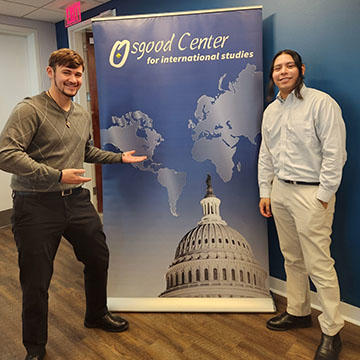
Double majoring in Global Studies with a concentration in Global Governance and Conflict and Spanish: Iberian and Latin American Cultural Studies.
When did you decide and what influenced your decision to major in global studies?
I have always been curious about the interconnectedness of our world and society. From a young age, I had the opportunity to reside in three different countries on two different continents. Thanks to that experience, I was able to meet people from diverse cultural backgrounds, sparking my curiosity to understand the multifaceted aspects of our global society. For that reason, as a senior student in high school, I applied to institutions with a Global Studies program.
During my sophomore year, I made the final decision to declare the Global Studies major after attending Dr. Gareth Potts’s GLBS 200: Intro Global Studies and GLBS 300: Global Studies courses. These classes provided me with a background in politics, international relations, and global issues. Additionally, the courses gave me different perspectives on how communities deal with global issues by using their culture, environment, and resources to create unique strategies to deal with current global issues.
What is the most valuable thing you have learned in your global studies coursework so far?
I have learned that every corner of the world has unique perspectives and narratives that can enrich our knowledge and broaden our life's perspectives. The interconnectedness of our global society is emphasized in the global studies coursework as it highlights the numerous possibilities of human development and progress without shying away from giving an extensive historical perspective on the complicated political, cultural, and economic events that have defined our current society.
What have you enjoyed most about your courses?
Learning from Dr. Eager and Dr. Potts is a joyous experience that is always enjoyable. However, what I have enjoyed the most from their courses is writing the research paper that they assign for their courses because it is always a chance to challenge myself, put my knowledge under scrutiny, and improve my writing abilities. Dr. Eager and Dr. Potts put a lot of effort into giving exceptional feedback to all their students. Hence, thanks to their feedback on the numerous research papers I have submitted to them, I have clearly seen a remarkable improvement in my writing abilities. I am grateful to them for all their support and their wonderful classes that never fail to spark my curiosity.
What co-curricular and extra-curricular activities related to global studies have you participated in so far?
Hood College's partnership with the United Nations Academic Impact made it possible for Dr. Eager to organize and lead a field trip to the United Nations Headquarters in New York City. In addition, students had the opportunity to meet with Omar Hernández, Program Manager of the United Nations Academic Impact, and ask for insights regarding the work and impact of the United Nations around the world. Learning about the history of the UN and being in person in the conference rooms, where important decisions that impact the world are made, was fascinating and euphoric.
During the Fall 2023, I joined the Model United Nations club and became the vice president. The club represented Pakistan and Madagascar at the National Model United Nations in DC, where both delegations were able to achieve the Distinguished Delegation Award.
Thanks to Hood’s partnership with the Osgood Center for International Studies, I was able to attend the Osgood Summer Symposium on Foreign Policy (Summer 2023) and the Leadership Program (January 2024). The participants were able to learn from experts in national Politics, U.S. Foreign policy, International Law, Leadership, Conflict Resolution, and many other academic fields. Furthermore, we were able to meet students from different countries, such as Germany and Austria, befriend them, and learn from each other.
Those experiences were pivotal in my journey as a Global Studies student, as they provided me with the opportunity to grow, network with experts, understand the world better, acquire more academic knowledge, and learn about career and educational opportunities.
Can you share a bit about your departmental honors paper in global studies?
My departmental honors paper focuses on the concept of race and discrimination in Latin America. As I stated previously, one of the most valuable lessons I have learned in the global Studies courses is that each region of the world has its unique perspectives and narratives. In Latin America, these concepts have a unique history, context, and social dynamics that date back to the beginning of the colonization of the Americas. Thus, they were not exported, but imposed. Therefore, in my honors paper, I would like to highlight that the Latin American region has its own unique perspective on race and discrimination that may conflict with some Western conceptual viewpoints. Immigration and refugees are topics of great debate in many countries. However, numerous times, the population in the host country lacks an understanding of the immigrant population. This creates conflict, misunderstandings, lack of respect, and social divisions. For that reason, I want to emphasize in my honors paper that having a diverse understanding of history and socio-cultural dynamics is essential when creating a dialogue between communities and dealing with global issues.
What would you like to do after you finish your degree and how well do you think your studies have prepared you for your career?
After graduation, I will travel to Europe, mainly to visit Italy and Spain, for some months. In my visit to those countries, I want to focus on appreciating the culture and better understanding their social and political systems. While traveling in Europe, also I want to make use of all the opportunities available to further improve my writing skills, take advantage of opportunities to provide social service, and join some cooking classes. Eventually, I plan to return to the U.S. to apply for graduate school and pursue a master's degree in International Studies. While I apply to continue my studies, I will also actively look for jobs in the DC area, maybe in a non-governmental organization. I know that the new journey after graduation is going to be challenging. Hood College, its partners, and all the experiences in the past four years have prepared me for my future plans. I am sincerely grateful to all my professors, fellow students, partner, and staff who supported me and provided guidance.
Ace Williams
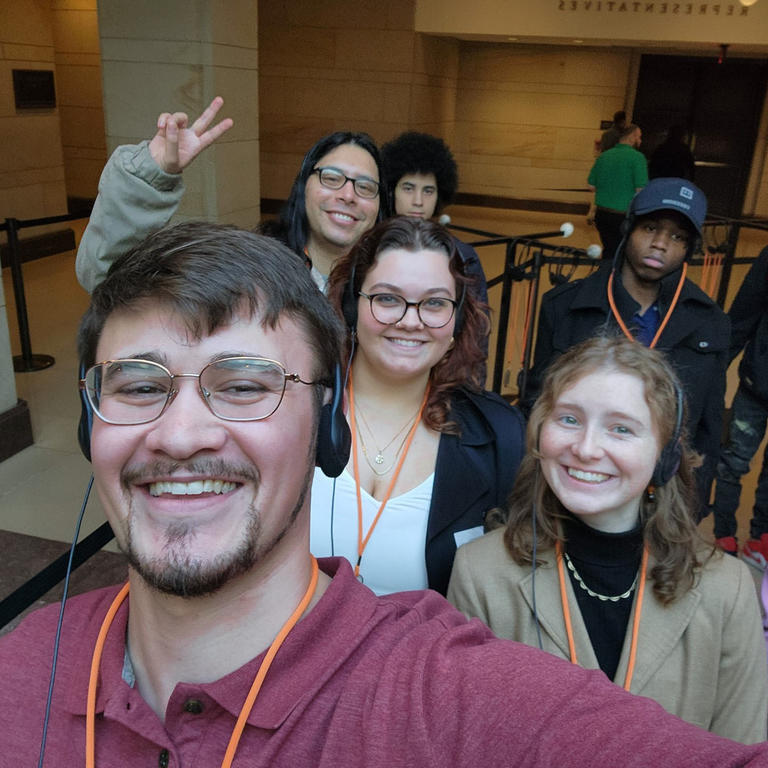
Spanish and Global Studies majors with a concentration in global governance and conflict.
When did you decide and what influenced your decision to major in global studies?
As an incoming (Fall 2022) transfer student, I had the privilege of taking an asynchronous summer course at no cost. I chose to take Introduction to Global Studies with Hood Adjunct Instructor Dr. Gareth Potts. I already knew I would be majoring in Hood’s excellent Spanish & Iberian Studies program, but I was uncertain what I would declare as my second major.
Immediately upon taking the course and thanks to Dr. Potts’ exceptional instruction, I became enamored with global studies, international affairs, geopolitics, and the like. By taking my first Hood course, I found my second major!
What is the most valuable thing you have learned in your global studies coursework so far?
My scholarship has always been motivated by my quest to understand “why things are the way they are today.” In Hood’s Global Studies Department, I have been challenged, encouraged, fulfilled, and grown much more competent as a global citizen. Indeed, the most valuable lesson I have learned through the program is that despite geopolitical and historical challenges, we all share our humanity and this world. Through the department’s education and related extracurricular activities, I have better understood how to navigate cultural differences (domestic and international). I see the necessity for each of us to overcome our differences to resolve the global crisis and conflicts facing us today.
What have you enjoyed most about your courses?
As head of Hood’s Global Studies Department, Dr. Paige Eager has designed the degree plan to inform students on a wide range of topics from terrorism and counterterrorism, the role of international organizations, stateless nations, the history and theory of international relations, the challenges and opportunities of globalization, the developing world and its unique challenges, and comparative politics. I enjoyed every second of Dr. Eager’s lectures. She would teach in such a way that captured my attention and excited me to learn more. I am grateful for Dr. Eager and Dr. Potts’ masterful and expansive instruction topics and their genuine interest in student success.
What co-curricular and extra-curricular activities related to global studies have you participated in so far?
Dr. Eager’s International Relations class was a great encouragement for me. At the end of the semester, we convened the class in a United Nations Security Council Simulation and learned how to represent the national interests of other countries. The experience encouraged me to join the Model United Nations Club in my second semester at Hood (Spring 2023). We represented Somalia in the International Model African Union Conference. We were fortunate enough to visit the Somali Embassy in Washington, D.C., to meet with Somali diplomats in preparation for representing their country. I became club president in the following semester (Fall 2023), and we represented Madagascar and Pakistan with 17 students at the National Model United Nations D.C. Thanks to the Osgood Center’s expert Model UN training program, both of our student delegations brought home awards for exceptional representation!
Thanks to Hood’s partnership with the United Nations Academic Impact educational organization, Dr. Eager organized and led a field trip to tour the United Nations Headquarters in New York City. This experience was awe-inspiring because we learned about the UN’s history and role in international relations experientially.
Through an institutional partnership with the Osgood Center for International Studies, I attended the Osgood Foreign Policy Symposium (Summer 2023) and the Osgood Leadership Program (January 2024). The founder of this non-profit educational organization, Dr. Shelton Williams, teaches students (domestic and international) through unique experiential learning opportunities. We had a rich array of experiences, such as visiting the GWU Elliott School of International Studies, the U.S. Capitol, museums, think tanks, the Philippine Embassy, the International Monetary Fund, and the Millenium Challenge Corporation. We learned from experts about geopolitics, U.S. foreign policy, domestic politics, leadership, and much more. We were able to network and learn about many internship, educational, and career opportunities.
If you’ve studied abroad, what was it like and what did you gain from the experience?
I will soon study abroad in Buenos Aires, Argentina, through Hood’s partnership with the Council on International Educational Exchange (CIEE) for my Spring 2024 semester. The former head of Hood’s Spanish program, Dr. Maria Griselda Zuffi, inspired me with her fascinating instruction on Argentine history and her personal connection to Argentina, which led me to select Buenos Aires as my study abroad destination. Fortunately, I will see her there. I expect to have an indispensably immersive language-learning and cultural experience while abroad. I excitedly anticipate living with my future Argentine host family and plan to travel as far and wide as my budget permits while taking advantage of all the unique experiences that beautiful Argentina will offer.
What would you like to do after you finish your degree and how well do you think your studies have prepared you for your career?
After graduating in September 2024, I will pursue a master’s degree in international affairs or international development studies at the George Washington University Elliott School of International Studies. While continuing my studies, I hope to work at the university and/or in the D.C. area to continue my immersive experiential learning of global studies. I have a great affinity for Latin America and will focus my future studies and career on the region.
Are you ready to say Hello?
Choose a Pathway
Information will vary based on program level. Select a path to find the information you're looking for!