
Elisha Kabongo ’27 on Student-Faculty Research
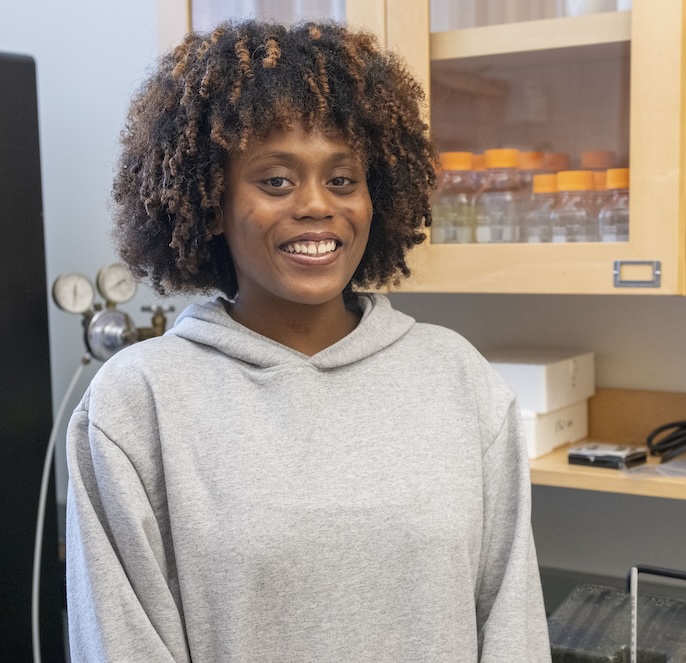
Elisha Kabongo ’27 conducts research on soybeans that leads to publication in scholarly journal and presentation at national conference.
Worth the Work
Program
- Biology (B.A.)
Department
- Biology
Biology major Elisha Kabongo ’27 participated in student-faculty research with Associate Professor of Biology Daehwan Kim, Ph.D., on transforming soybean straw into commercial products. Their research led to the publication of two articles in the scholarly journal “Frontiers in Bioscience-Elite” as well as a presentation at the 2026 National Conference on Undergraduate Research in Richmond, Virginia. In the conversation below, Kabongo discusses the impact of her research, her internship with AstraZeneca, and the experience of publishing and presenting her work.
Tell us about your research on soybeans—what did the project entail? What were you setting out to prove/analyze/test?
This research under Professor Kim focused on turning soybean agricultural waste into a valuable commercial product, such as lactic acid, which has many uses, including in food production and pharmaceuticals, but is especially beneficial because it can also be used to produce polylactic acid (PLA), a biodegradable plastic. In this research, we used soybean straw and compared raw soybean straw with samples pretreated with sodium hydroxide and hydrogen peroxide. After pretreatment, we used enzymatic hydrolysis to break down the cellulose and hemicellulose into fermentable sugars. We then used Lactobacillus pentosus to ferment those sugars into lactic acid. We wanted to analyze how the different pretreatments affected sugar production and, ultimately, how efficiently soybean waste could be converted into a valuable product like lactic acid.
What was the biggest surprise you found during your research?
One of the biggest surprises was seeing how much of a difference the pretreatment method could make. The sodium hydroxide-treated soybean straw resulted in the highest sugar conversion compared with the other soybean straw samples, which showed me how important each step of the process is. I also didn’t realize at the start of the project that something considered agricultural waste could potentially be turned into a useful product like lactic acid.
What did you enjoy most about working alongside Hood faculty?
What I enjoyed most was how supportive and patient Professor Kim is and how much he trusts us with our research. He gives us in-depth knowledge about what we will be doing before we go into the lab, which gives us a strong foundation. At the same time, he gives us independence and trusts us to figure out our schedules, especially when an experiment lasts several days. He also lets us work independently in the lab, which makes the experience feel much more like what scientists do in the real world. I have worked with Professor Kim for almost three years, and this experience has made me much more confident and independent in the lab.
How did the research project complement your biology major?
This research reassured me that biology was the right major for me. When I started college, I wasn’t 100% sure biology was what I wanted to pursue. However, working with Professor Kim and having such a positive research experience helped solidify that decision. It also helped me land an amazing internship opportunity at AstraZeneca, where I worked with fermentation similar to what I had been doing with Professor Kim. My supervisor at AstraZeneca told me that my previous research experience at Hood played an important role in me getting the position. It was really rewarding to see something I started doing as an undergraduate directly prepare me for an opportunity at a major biotechnology company.
What was it like presenting your research at the National Conference on Undergraduate Research?
Presenting at the National Conference on Undergraduate Research was a really great experience with my research partner, Erica Corell ’26. It was my first time presenting at such a large conference, so it was definitely nerve-racking at first. Once we got to our station and presented to the first person, though, we got into a nice rhythm and became much more comfortable. We also connected with students from all over the country and learned about the amazing research they were doing. I also connected with some of them on LinkedIn. Representatives from different universities were also there, which allowed me to learn about potential graduate schools and build those connections as well.
How did it feel to see your research published in a scholarly journal?
Seeing the research published made me feel extremely accomplished. It also helped me better understand how impactful scientific research can be, whether that impact is economic, environmental or directly related to people’s health. It is amazing to read a scholarly article and know that I was part of the work behind it and contributed, even in a small way, to research that could make a difference.
Why should other Hood students consider getting involved with student-faculty research?
Student-faculty research is great hands-on experience before entering the professional world. I can only directly speak from the biology side, but working under Professor Kim gave me an incredible foundation for success in the lab. I already understood many aspects of lab work, including conducting experiments, troubleshooting when things didn’t go as planned and working independently. Even if you are not a biology major, research allows you to apply what you learn in class to something real. Instead of completing something just for an assignment or grade, you are contributing to an actual project and gaining experience that can help you figure out what you want to do in the future.
Learn more about student-faculty research in the Department of Biology.
Are you ready to say Hello?
Choose a Pathway
Information will vary based on program level. Select a path to find the information you're looking for!