
Elizabeth Ambos, MFA’27, Publishes Debut Poetry Chapbook
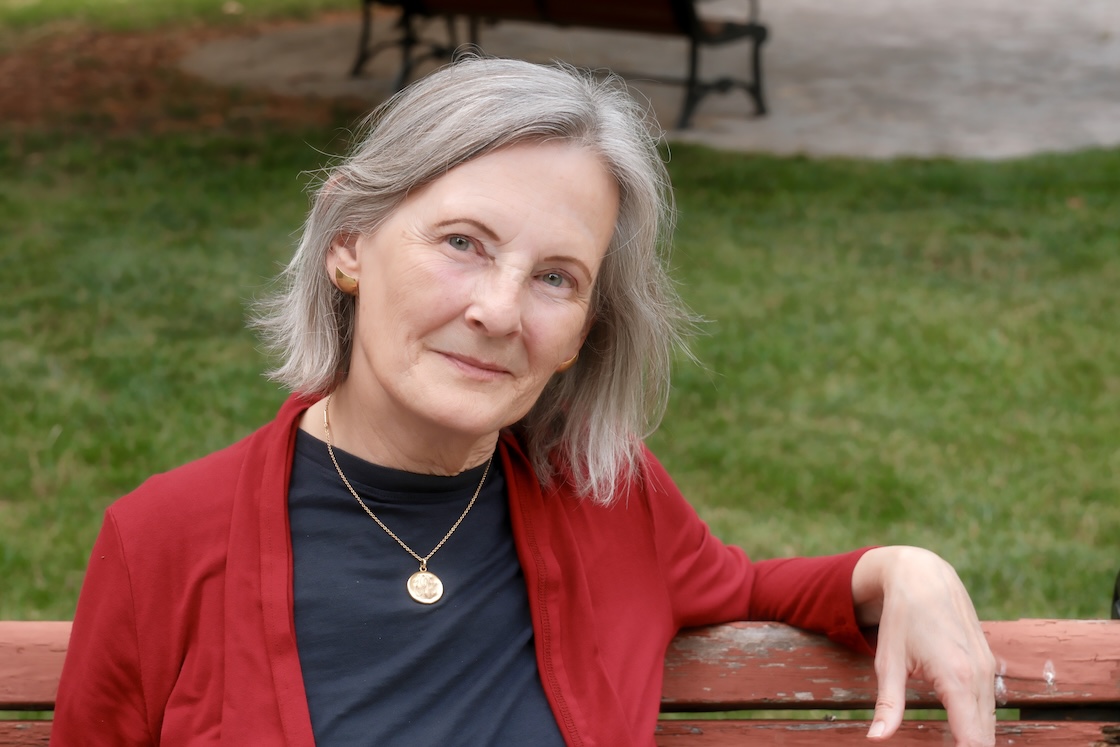
“Smoked Glass Lens” explores loss and grief through the lens of science and nature.
Q&A
Program
- Creative Writing (MFA)
Department
- English
Elizabeth Ambos, MFA’27, is a current student in the low-residency creative writing MFA program at Hood College. Her debut poetry chapbook, Smoked Glass Lens, was recently published by Dancing Girl Press. Her work has also appeared in Wild Roof Journal, Gramercy Review, Tangled Locks Journal, Please See Me, Dos Gatos Press and Cagibi. After a long career in higher education and nonprofits, Ambos transitioned to consulting and is now pursuing her MFA. In the conversation below, Ambos discusses what attracted her to poetry, the experience of fine-tuning her manuscript for publication and how her time at Hood has shaped her writing process.
How did you fall in love with writing? Was there a particular book or author that hooked you?
I was born into a family of avid readers. Both my mother and father saved books from their own childhoods and passed them on with great ceremony to their three children. Every birthday, every holiday, we would get books as presents. Weekly trips to the town library were treasured rituals. And writing was always in the forefront. My father trained as an engineer but made a career as a technical writer. My mother was an expert copy editor and indexer. So it’s no wonder I became entranced with reading and writing at an early age. There were so many books in my childhood that hooked me. With regard to poetry, however, I clearly remember receiving This Way, Delight at age eight: a poetry anthology that I would reread once a year into adulthood.
What led you to pursue an MFA in creative writing? And why did you decide to pursue your studies at Hood?
I started writing poetry in my teens, and in high school, I focused on literature, languages and history. I was also a theater kid. Then I went to college and fell desperately in love with science and mathematics, especially geology. I obtained my Ph.D. in marine geology and geophysics and was fortunate to obtain a faculty position after my post-doctoral appointments. Following a multi-decade career as a faculty member and administrator at public higher education institutions in California, I moved to Washington, D.C., in 2012 to take the role of executive officer for a nonprofit, transitioning in 2019 to work as a consultant on several grant-funded projects.
But creative writing, particularly poetry, was occupying more and more space in my brain, and I was waking up at 3 a.m. to write. So in 2024, I took the plunge and applied to the Pocket MFA program, a 10-week program that gives a taste of the MFA process. It was a great learning opportunity, but I began looking around for low-residency MFA programs in the greater D.C. area, as I was interested in an immersion experience to expand my craft, my community and my connections to the vibrant DMV creative ecosystem. Writer Robert Eversz was actually the main messenger for Hood’s MFA, as he posted a notice about it for the Pocket MFA community in early 2025. The rest, as they say, is history! Hood College’s program was the perfect fit for me. I’m so proud to be part of Hood’s second MFA cohort.
Congrats on the publication of your chapbook, Smoked Glass Lens. Can you share a bit of background on how these poems came to be and what inspired the collection?
Thank you! It’s been a journey. Some of these poems have been in the works for several decades, others have come into being in the last year or two. The main reason I write poems is to make sense of what I’m observing and to share that sense with others. Many of us struggle to deal with losses of dear friends and family members, and many of the poems in this chapbook deal with losses I’ve experienced. Smoked glass lenses used to be the way that viewers would look at the sun’s eclipse. I adopted that phrase as my chapbook title, as a metaphor for how we look at the burning past: imperfectly yet bravely. It’s a dangerous but essential process.
What was the editing and publishing process like? What surprised you the most?
I workshopped most of the poems over the past few years, some in the course of my first residency at Hood last summer. Most poems went through eight to ten revisions before I was satisfied they were ready to show to a publisher. The most challenging parts of the process were researching the publishers that would be a good fit for my work and pitching the chapbook to them. One of the most surprising aspects of the chapbook’s creation was the amount of time spent playing with different groupings of poems. I felt it was important that the order of poems in the chapbook provide structure for readers yet not be too obvious. So there are some deliberate juxtapositions of different themes.
How has your time in the Hood MFA program informed your work?
Reading more broadly than ever before, sharpening my poetic craft and knowledge of different theories and schools of thought, serving as poetry editor for the new Pergola Literary Magazine, and exposure to a diverse and supportive community of amazing writers and mentors are all informing my work. The leaders of the MFA program—Dorian Elizabeth Knapp, Aaron Angello and Amy Gottfried—provide a warm and welcoming environment for writers to connect and learn from each other.
What are the benefits of being in a low-residency program? What do you enjoy about the format?
For many of us with work and/or family responsibilities, low-residency or no-residency are realistically the only ways to go. I looked at several other low-residency programs but kept coming back to Hood. The combination of the quality of the faculty and students engaged in the program, the beautiful Hood College campus, and the amenities offered in Frederick and surrounding communities make Hood’s MFA an attractive program. Each student launches their Hood MFA with the 10-day summer residency immersion experience, which allows everyone involved to get to know each other’s work and socialize. You bond with your mentors and other writers, so the subsequent online coursework during the year builds from a place of trust.
Do you have any advice to offer new writers who are interested in publishing?
Don’t be afraid to fail, and don’t try to “perfect” your work before submitting. There are poems in the chapbook that I still want to tweak. Be confident yet humble at the same time. Talk to your mentors and other writers about which publishers might be good matches for you. Familiarize yourself with different publishing options and different software platforms to organize your submittals, and read books published by presses that you would like to approach. Become a reader for at least one journal that you like, if you can swing it. And, of course, consider applying to a creative writing MFA program like Hood College’s, where you will have many opportunities to bring your writing to the next level, and thus be well positioned to publish your work.
Learn more about the creative writing MFA program at Hood College.
Are you ready to say Hello?
Choose a Pathway
Information will vary based on program level. Select a path to find the information you're looking for!