
Foreign Study Affects "Profound" Growth in Students
Scott Pincikowski, Ph.D., Professor of German and Foreign Study Program Director, wants educational travel opportunities for all Hood students.
Scott Pincikowski, Ph.D., Director of Foreign Study, looks forward
Department
- Global Languages & Cultures
Title
Professor of German
Scott Pincikowski, Ph.D., knows what it's like to have purposeful travel positively influence the direction of your life, and he wants Hood students to have that opportunity as well. How can alumni and friends help, and even participate in Hood travel programs? Read on....
How is the study abroad program at Hood currently structured?
Study abroad at Hood consists of long and short-term programs. Most students studying long-term go abroad for a semester, whereas short-term programs last anywhere between one to six weeks. Short-term programs are often faculty-led trips that are tied to coursework at the College.
Recent trips include:
- Tropical Marine Biology trip to the Bahamas led by Dr. Drew Ferrier and Dr. Lori Wollerman
- Education trip to Scotland led by Dr.Tricia Strickland and Dr. Amy Kilpatrick
- French and Art History trip to Martinique and Guadalupe led by Dr. Lisa Marcus and Dr. Kimberly Morse-Jones(which is now being offered for Alumni in 2027!).
Each year, Hood students have access to new and exciting experiential learning opportunities abroad. This upcoming year:
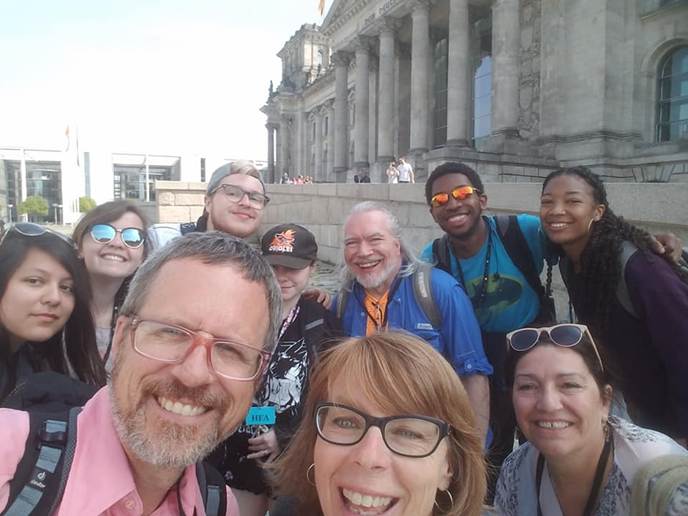
- Dr. Robert Casas and I are planning a spring 2027 trip to Barcelona and Berlin [see photo in gallery below of a previous trip] exploring memory sites connected to the Spanish and German dictatorships.
- Dr. Strickland and Kilpatrick are offering their trip to Scotland for a second time.
Which travel programs are the most popular among students? How do students apply?
Most students apply to either CIEE or CEA CAPA, which are large study abroad providers that offer both short and long-term programs. Students apply directly to the study abroad providers. There is also paperwork that students must fill out for the Study Abroad Office and the Registrar’s Office at Hood.
Any examples of world events that could affect these student trips?
Safety is the top priority for the College when sending students abroad. The College follows the guidelines for safe travel established by the U.S. State Department. If the travel advisory, which includes war, health crises, natural disasters, crime levels, political unrest, etc. is at level 4 (Do Not Travel), Hood students are not allowed to participate in programs as part of their college experience.
The College also recommends that students sign up for the State Department’s Smart Traveler Enrollment Program (STEP) to receive email updates from the local U.S. embassy or consulate about current conditions in the country/countries they are traveling to.
What would you like Hood alumni know about foreign study at Hood, and how can they support students who want to participate?
Study abroad is an integral part of the Hood College experience and is one of the most meaningful HIPs (High Impact Practices), which is a part of the core curriculum. The College has identified study abroad as one of the most transformative experiences that students can have during their time at Hood College.
The best way for alumni to support Hood students study abroad is to donate scholarship money to help defray tuition fee and travel costs, which is the biggest hurdle for students going abroad. Through generous donors we do have existing scholarships, but with travel costs increasing each year the need for more scholarship money does, too.
How has purposeful travel shaped you as a person?
Travel has shaped me in so many ways. I would not be a German professor nor the study abroad director at Hood if travel wasn’t one of my life’s passions. One thing that I tell students when I meet with them about study abroad is how much travel and study abroad will change them in profound ways, making them more mature, resilient, and self-reliant individuals who can navigate new and challenging situations and experiences with confidence. I also tell students that they will become more empathetic and open-minded.
Learning to communicate cross culturally is so liberating, teaching them to appreciate and celebrate cultural differences, while turning a critical eye toward their themselves and their own home country and culture.
Your favorite place on the planet to spend time (and why):
This is a difficult question to answer, as I am always looking for that new favorite place. That is one of the many joys of travel. You see so many amazing things and meet so many incredible people that it leaves you wanting more similar experiences.
If I had to choose a place in the United States it would be Tuolumne Meadows in the high Sierras in Yosemite National Park. The sublime mountains and flower-filled meadows there bring me such inner peace.
If I had to choose a place abroad, it would be Innsbruck, Austria. I was fortunate to spend a semester teaching and researching there as a Fulbright scholar. I had so many formative experiences there, teaching, hiking in the Austrian Alps, and making Austrian friends, that it holds a special place in my heart.
Location that is highest on your bucket list to visit next (and why)
Again, it is hard for me to choose one place! I would love to travel to Madagascar, Kenya, or South Africa. I am a huge nature lover who just completed a Masters in environmental biology at the College and would love to travel to these places that have great biodiversity and endemic species that are so different from what we have here in North America.
Foreign Study, Berlin Trip
Are you ready to say Hello?
Choose a Pathway
Information will vary based on program level. Select a path to find the information you're looking for!