
Honors Program Curriculum
Mind-Expanding Classes—Different, Not More
The Honors Program is meant to enrich your college experience rather than piling on extra work. To that end, we have designed a curriculum that allows you exemptions from certain core classes in exchange for completing levels of Honors coursework.
You also have flexibility in fulfilling upper-lever Honors requirements—Honors electives, study abroad, writing a departmental honors paper or honors thesis.
Honors classes are enhanced by field trips, guest speakers and a variety of hands-on activities and special projects. In keeping with the collaborative nature of the program, students meet as a group to decide on the topics of their senior seminars and suggest faculty they would like to teach them.
Curriculum
HON201-01 Global Challenges with Climate Change T/Th 11:25am-12:50pm, Dr. Scott Pincikowski
Prerequisite: HON 102, or admission to the Honors Program as a sophomore
This course explores how countries around the world perceive and tackle the problem of climate change. Students will investigate the problem of climate change through the lens of the Environmental Humanities. Throughout the term, we will investigate how cultural attitudes towards the environment differ around the world and how these attitudes impact the level of response to the climate crisis. In addition, we will investigate how different modes of cultural expression such as literature, film, music, and art suggest new ways for thinking about climate change and even afford opportunities for imagining more optimistic futures. To pursue such an investigation, students will analyze and situate a variety of primary and secondary sources within broader debates and discourses—scientific, historical, and political—about climate change. Overall this course focuses on developing the necessary tools and skills for thinking, writing, and speaking critically about both the Humanities and climate change.
HON201-02 Religious Music, TTH 9:50am-11:15am, Dr. Noel Verzosa
Prerequisite: HON 102, or admission to the Honors Program as a sophomore
Many religious traditions have incorporated music into their practices and rituals, from Gregorian chant to the singing of Hindu mantras to gospel music to Rastafari drumming. There are exceptions: some religions have put strict constraints on how music can be used in religious contexts; other religions have banned music altogether. In this class we will survey several religious traditions and discuss how music was used to enhance and/or symbolize their beliefs and practices. Conversely, we will discuss how and why the technical features of music, as opposed to visual art or language, have been deemed appropriate for inappropriate for expressing religious values and ideologies. (Note: no prior musical experience is required for this course.)
HON201-03 The Body Keeps Score, MW 11:30am-12:55pm, Dr. Maria Taylor
Prerequisite: HON 102, or admission to the Honors Program as a sophomore
This 200-level Honors course uses Bessel van der Kolk’s The Body Keeps the Score to explore how trauma reshapes the brain, mind, and body, and how healing becomes possible through neuroplasticity, relationships, and body-based practices. Students will examine trauma’s physical and psychological impact, consider approaches such as neurofeedback, yoga, mindfulness, EMDR, and expressive arts, and reflect on their own “brain, mind, and body scores” across the lifespan. Emphasizing equity and social context, the course investigates how factors like race, gender, class, and exposure to chronic stress shape both vulnerability to trauma and opportunities for recovery, preparing students to think critically about what truly trauma-informed, healing-centered systems that prioritize safety, trust, equity, and empowerment might look like.
HON201-04 Love Across Boundaries and Borders, M/W 11:30am-12:55pm, Dr. Karen Hoffman
Prerequisite: HON 102, or admission to the Honors Program as a sophomore
This course explores some of the conceptions, expectations, norms, and practices of love, particularly romantic love, across social, cultural and religious boundaries and geographical borders. It uses novels as well as philosophical sources to examine what we take love to be, what role it plays in our lives, what cultural contexts encourage it to flourish and when it is mutually empowering.
HON304-01 Censorship in America, Monday 5:10pm-7:55pm, Professor Howard Scher
Prerequisite: Sophomore, junior or senior standing in the Honors Program, or permission of the instructor
This course examines the historical and contemporary aspects of censorship in America, paying particular attention to government and societal attempts to repress speech, press and the arts
HON368 American Landscapes: Environmental Literature in the US, M/W 9:50am-11:15am, Dr. Amy Gottfried
Prerequisite: Completion of any 200-level English course; or permission of instructor
How does the American landscape function in our imagination, our literature, our understanding? This reading-intensive course covers a wide range of environmental works: literary, scientific, philosophical, autobiographical. Selected works include Walden, Pilgrim at Tinker Creek, Ceremony, and Braiding Sweetgrass. Students will also get a chance to explore and write about their own "landscapes."
HON397M Living with Violence El Salvador, TTH 11:25am-12:50pm, Dr. Gracia Lopez
Prerequisite: Sophomore, junior or senior standing in the Honors Program, or permission of the instructor
“El Salvador is now the safest country in the Western Hemisphere.” President Nayib Bukele says so. Headlines repeat it. Crime rates drop. Prisons fill.
But Honors students ask harder questions: Safe for whom? At what cost? And who decides what safety means?
This seminar takes you beyond the headlines into one of the most urgent debates in global security today. Using El Salvador as a case study, we examine how violence, fear, and survival shape everyday life and how states respond when insecurity becomes political currency—over generations.
But this is not a policy course. It is a human one. We will sit with stories of civil war, displacement, and memory. We will trace how violence travels across generations and borders. We will explore what security feels like in real life, in neighborhoods, in families, in silence, and in resilience.
We will also show how this shapes culture. We will embrace the diaspora, share pupusas, music, and traditions connected to Salvadoran identity. At the same time, we will ask what those practices carry, including memory of war and survival. Culture becomes a way of understanding what politics fails to explain.
Grounded in interdisciplinary research and real-world evidence, this course challenges you to weigh tradeoffs between safety and democracy. El Salvador is a mixed bag of security and control, pride and pain, order and uncertainty.
This course is for students willing to sit with that complexity...and yes, there will be pupusas.
HON470-1 Entrepreneurship, TTH 11:25am-12:50pm, Dr. Marc Dupont
This Honors course introduces students to the foundational principles of entrepreneurship through a personalized, interest-driven approach. Guided by each student’s field of interest and future career goals, the course explores how entrepreneurial thinking can be applied across a wide range of fields.
Students will examine the journeys and strategies of successful entrepreneurs within their areas of interest, gaining insight into how ideas are developed, launched, and sustained. Key topics include marketing and branding, funding and investment strategies, the integration of artificial intelligence, and the tools, resources, and support systems available to emerging entrepreneurs
Honors Program
The Hood College Honors Program is a four-year program of coursework, co-curricular events, and extracurricular activities. Honors courses, which are designed to cultivate students’ ability to examine our complex world, are interdisciplinary in approach and are often team-taught. Classes are small, discussion-oriented, and frequently enhanced by guest speakers and field trips.
The Honors Program has the following requirements:
- FYE 101H and FYE 102H (First-Year Experience) during first year
- HON 201 and HON 202 taken during sophomore year
- At least one 300-level HON elective
- HON 470 taken during the senior year
- In addition, students must complete at least one of the following FOUR things:
- Demonstration of 202-level proficiency in a modern global language (other than English or American Sign Language); OR
- A second 300-level Honors elective; OR
- A Departmental Honors project in their major (499A/499B) or HON 499; OR
- A semester of study abroad
GPA Requirements
To remain in good standing in the Honors Program, first-year students are required to maintain at least a 3.0 GPA. Sophomores, juniors, and seniors are required to maintain at least a 3.25 GPA. Students who have a GPA that falls below the minimum requirement will be placed on probation within the program or dismissed from it.
Grade Requirements
A grade of “C-” or better is required in each Honors course being used to satisfy the Program requirements.
- Any student who receives a grade lower than a C- in FYE 101H will be dismissed from the program.
- Any student receiving a grade lower than C- in HON 102, HON 201, or HON 202 may be dismissed from the program. If allowed to continue in Honors, the student will need to repeat that course the next time it is offered and earn a grade of C- or higher in order to fulfill the program requirements.
First-Year Honors Experience
First-year students in the Honors Program take two Colloquium courses organized around interdisciplinary themes.
- FYE 101H First Year Seminar-Honors Colloquium I
- FYE 102H Honors Colloquium II (Linked Course to FYE 101H section)
Sophomore Year Honors Experience
The sophomore year in Honors helps students to explore the nature of knowledge, cultural differences, and the individual’s place in society.
During the second semester (HON 202) students combine scholarly research with experiential learning in the community.
- HON 201 Topics in Diversity (counts for Diversity requirement of the HMH Core)
- HON 202 Ethics of Service Learning (counts for Ethics requirement of the HMH Core)
- In addition, students must complete at least one of the following FOUR things:
- Demonstration of 202-level proficiency in a modern global language (other than English or American Sign Language); OR
- A second 300-level Honors elective; OR
- A Departmental Honors project in their major (499A/499B) or HON 499; OR
- A semester of study abroad
Selected first-year students may begin the program at the end of their first or second semester at Hood. These students begin taking Honors courses at the time of their entry into the program and exempt earlier Honors courses.
Honors Experience in Junior and Senior Years
Students in the Honors program will complete at least one Honors course at the 300-level and HON 470 Seminar. HON 470 must be taken during senior year and may not be repeated. In addition, students must either demonstrate 202-level proficiency in a global language, take a second 300-level Honors elective, complete a Departmental Honors project, OR complete a semester of study abroad.
As an alternative to a Departmental Honors project in their major, students in the Honors Program may elect to complete a 3-credit interdisciplinary HON 499 project during the fall or spring semester of the senior year.
Relationship to the Core Curriculum
The first four Honors courses (FYE 101H, FYE 102H, HON 201, HON 202) count toward the Hearts, Minds and Hands Core. FYE 101H and FYE 102H are the required First-Year Experience, HON 201 fulfills the Diversity requirement in the MIND section of the Core, and HON 202 fulfills the Ethics requirement in the MIND section of the Core.
Early College Students
The Honors Program welcomes qualified early college students who have completed an AA, or equivalent, during their high school years. Students with 30 or more credits from International Baccalaureate (IB) programs may also qualify, with director approval.
Early college students must take the First Year Seminar in their first semester at Hood. Their progression through the Honors Program is as follows:
- FYE 101H First Year Seminar-Honors Colloquium I
- FYE 102H in spring semester first year (course linked to FYE 101H section)
- 1 300-level Honors elective
- 1 Hon 470
- In addition, students must complete at least one of the following FOUR things:
- Demonstration of 202-level proficiency in a modern global language (other than English or American Sign Language); OR
- A second 300-level Honors elective; OR
- A Departmental Honors project in their major (499A/499B) or HON 499; OR
- A semester of study abroad
Transferring into the Honors Program
The Honors Program welcomes qualified transfer students. Those who have successfully completed two years of an honors program at another college or university before transferring to Hood may enter the Hood College Honors Program at the junior level. In order to complete the program, such students must take HON 470 and one other 300-level Honors Program courses. They must also complete one of the FOUR options below:
- Demonstration of 202-level proficiency in a modern global language (other than English or American Sign Language); OR
- A second 300-level Honors elective; OR
- A Departmental Honors project in their major (499A/499B) or HON 499; OR
- A semester of study abroad
Students who transfer to Hood without having completed two years of an honors program at another college or university, may also join the Honors Program. They must complete: HON 201, HON 202, HON 470, and at least one other HON course at the 300-level. They must also complete one of the FOUR options below:
- Demonstration of 202-level proficiency in a modern global language (other than English or American Sign Language); OR
- A second 300-level Honors elective; OR
- A Departmental Honors project in their major (499A/499B) or HON 499; OR
- A semester of study abroad
Students who place in and complete a 203, 204, or civilization course-level French, German, or Spanish course during the first semester at Hood with a grade of C or above earn 6 additional credits. No additional credits are awarded for students already awarded transfer credit for French, German, or Spanish 201 and 202.
Recognition of Honors Students
To graduate from the Honors Program, students must earn a cumulative GPA of at least 3.25. Students who fulfill the Honors requirements will earn Honors Program recognition on their academic records.
Students take two seminar classes, FYS 101H in the fall semester and HON 102 in the spring. In addition, most students start their language requirement in the first semester, depending on placement. Check with your advisor and the Honors directors for recommendations.
FYS101H
The fall Honors First-Year Seminar (August-December) is team-taught by professors from different disciplines. Students will acquire skills in critical thinking, writing, and speaking as well as general skills for success in college and in their future.
FALL 2024 topics
Click the titles below to learn more about each topic. Honors students may choose the topic that interests them most. History & the City and Arts & the City are team-taught, as are Local Lore and Legends and The Art of Wandering, so students will get to experience two related topics with two different professors. Your "home" professor will also be your academic adviser until you declare your major.
- History & The City with Dr. Mallory Huard, History
- Arts & The City with Dr. Noel Verzosa, Music
- Local Lore and Legends with Dr. Lisa Marcus, French and Gender Studies
- The Art of Wandering with Dr. Kimberly Morse Jones, Art History
Recent field trips for the Honors fall seminar have included:
- The National Building Museum in Washington, D.C.
- Performances at The Kennedy Center in Washington, D.C.
- Zipline and obstacle course outing at Tree Trekkers in Frederick
- Walking tour of the Tidal Basin monuments, Washington D.C.
- Escape room adventures at ClueIQ in Frederick
- The National Museum of African American History and Culture, Washington D.C.
HON102
In the spring semester (January-May), students may choose one of four different sections of HON102. Each class focuses on a topic that takes an interdisciplinary approach to the sciences and technology in relation to society.
Some recent topics:
- Movie Magic: Science in Film
- Thinking about Thinking
- Plagues and Peoples
- Sustainable Diets
Recent field trips for the spring have included:
- U.S. Botanic Garden, Washington, D.C.
- National Museum of Civil War Medicine, Frederick, Md.
- Lunch at a local farm-to-table restaurant, The Orchard, in downtown Frederick
- The National Zoo, Washington, D.C.
- Antietam National Battlefield, Sharpsburg, Md.
- Collaborative work with local farms for sustainable diets class
Students take two seminar classes, Hon 201 in the fall semester and Hon 202 in the spring. In addition, most students finish their language requirement (through the 202 level) in the second semester of their second year, depending on placement. Check with your advisor and the Honors directors for recommendations.
HON201
Students can choose from a menu of classes that focus on global issues and differing cultural perspectives for HON 201, the fall seminar. They will be encouraged to imagine the world from many points of view and challenged to examine how they think about and interact with the global community.
Sample classes:
- Global Climate Change
- LGBTQ+ Global Perspectives
- Global Inequity
- Politics and Ethics
Class field trips for HON 201 have included:
- Symposium on January 6th, Washington D.C.
- Frederick County landfill
- Crime Museum, Washington D.C.
HON202
Students will work closely with a faculty advisor of their choice for the spring semester practicum. Each student chooses a social or intellectual problem to address, writes a research paper and works at an off-campus site, gaining experience and connections that may also lead to paid employment or help determine a future career. The broad, overarching theme of this class is social justice, but the sites students at which students have chosen to volunteer are many and varied.
Recent practicum sites have included:
- Heartly House
- Frederick Health Hospital
- Housing Authority of Frederick
- Delaplaine Visual Arts Center
- Frederick Rescue Mission
- I Believe in Me
- Civil War Medicine Museum
- Halfway African American Cemetery
- Monocacy National Battlefield
Sample research papers:
- “Power Shifting and Getting in Gear: The Youth Movement Toward a Sustainable Future” Site: Energy Action Coalition
- “19th Century Health Care” Site: National Museum of Civil War Medicine
- “Environmental Justice Through the Eyes of the Deep Ecologist” Site: Catoctin Zoo
- “Slavery and Social Injustice”
- “Acid Victims: A Spotlight on Social Injustices Faced by Women in South Asian Countries” Site: Frederick Memorial Hospital
Students choose upper-level honors electives from a wide array of options, many of which are based on student requests. Students may also elect to study abroad; sites chosen by Honors students include France, Spain, England, Ireland, Scotland, Germany, Italy, Mexico, Israel, Korea and New Zealand. Study abroad counts as one honors elective. Students who successfully complete a departmental honors paper also receive credit for one honors elective.
Sample Honors electives:
- Impact of Social Media on Society
- Censorship in America
- Revisioning Motherhood in Modern Western Culture
- The Chesapeake Bay
- Food and Culture
- American Landscapes: Environmental Literature in the US
- Exploring Utopia
Class field trips for upper-level electives have included:
- Museum of African Art, Washington, D.C.
- Maryland State Police Computer Forensics Lab, Columbia, Md.
- Special Beginnings Birthing Center, Arnold, Md.
- National Gallery of Art, Washington, D.C.
The senior seminar is a high point of the honors program, when students reflect on their experience in the Honors Program. Students choose a topic of broad interest and select a faculty member to teach the course. Sample seminar classes:
- Beauty and Culture
- Impact of Social Media on Society
- Philosophy of Love and Sex
- Why Us? The Success and Failure of Humanity
The Honors Program welcomes qualified transfer students. More information about the requirements for transfer students can be found in the Hood College Catalog. Requirements differ depending on the level of involvement a student had with Honors at their prior institution. Transfer students work closely with the Honors co-directors to identify which requirements of the Honors Program apply to them.
Transfer students may satisfy the Honors global language requirement in one of the following ways:
- Demonstrate proficiency in a global language through the 202-level (by coursework or placement exam)
- Successfully complete any two global language courses
- Complete one global language course and one approved culture course:
Complete one global language course and one of the following:
ANTH 302 Cultural Anthropology
ECON 304 International Political Economy
ECON 317 Economics of Development
GER 301 Berlin in the 20th Century
GLBS 301 Human Migrations: Refugees and IDPs
GLBS 345 Global Persp/Women, Power & Politics
HIST 347 The Indigenous World
HIST 356/357 Global Empires I/II
HON/PHIL 316 Perspectives in Global Health
MEST 300 Cultures of the Middle East
NUR 300 Global Learning Exp/Healthcare & Nursing
The Honors Program welcomes qualified early college students who have completed an AA, or equivalent, during their high school years. Students with 30 or more credits from International Baccalaureate (IB) programs may also qualify, with director approval.
Early college students must take the First Year Seminar in their first semester at Hood. Their progression through the Honors Program is as follows:
- FYS 101H First Year Seminar Honors
- HON 202 in spring semester first year
- 2 300-level Honors electives (or substitute study abroad or departmental honors)
- 1 Hon 470
They are considered transfer students for the purpose of Honors Program language requirements, which means they may satisfy the global language requirement in one of the following ways:
- Demonstrate proficiency in a global language through the 202-level (by coursework or placement exam)
- Successfully complete any two global language courses
- Complete one global language course and one approved culture course:
Complete one global language course and one of the following:
ANTH 302 Cultural Anthropology
ECON 304 International Political Economy
ECON 317 Economics of Development
GER 301 Berlin in the 20th Century
GLBS 301 Human Migrations: Refugees and IDPs
GLBS 345 Global Persp/Women, Power & Politics
HIST 347 The Indigenous World
HIST 356/357 Global Empires I/II
HON/PHIL 316 Perspectives in Global Health
MEST 300 Cultures of the Middle East
NUR 300 Global Learning Exp/Healthcare & Nursing
Mind-Expanding Classes—Different, Not More
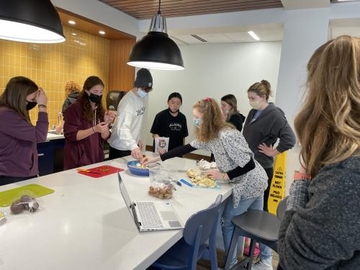
Honors 102 students sample fruits from other continents as they learn about sustainable diets!
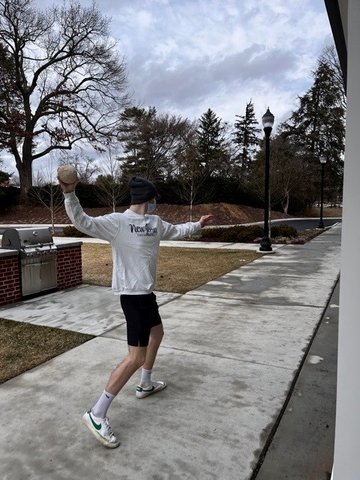
In the Sustainable Diet course, students explored foods from a variety of cultural traditions and parts of the world.
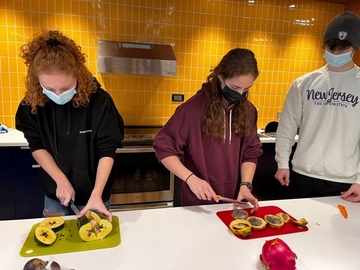
In the Sustainable Diet course, students explored foods from a variety of cultural traditions and parts of the world.
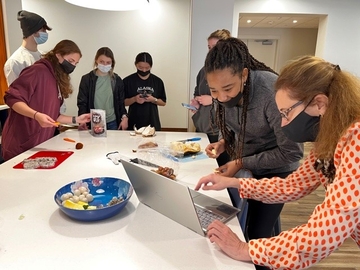
In the Sustainable Diet course, students explored foods from a variety of cultural traditions and parts of the world.
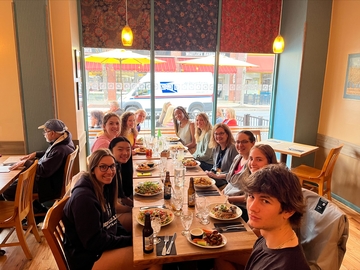
Honors class, The Sustainable Diet, evaluating the Orchard Restaurant downtown Frederick as a Farm to Fork restaurant with Gina Gohl from the Hood College Food Security Network.
Are you ready to say Hello?
Choose a Pathway
Information will vary based on program level. Select a path to find the information you're looking for!